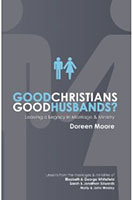
CHECK YOUR PULSE…IF YOU DON’T SHED A TEAR
Leave a reply

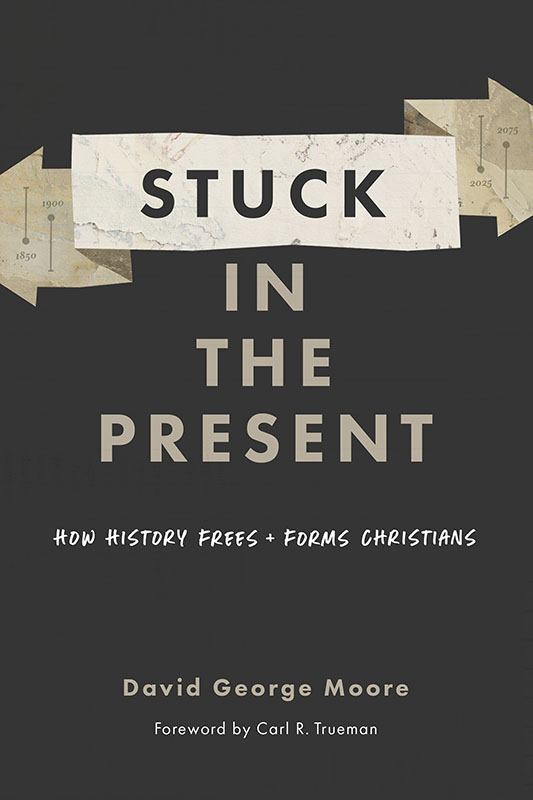
Stuck in the Present
My wife and I were talking about a piece she read by Tim Keller in which he describes two types of people:
Those who get what they want and are not happy
Those who do not get what they want and are not happy
My wife took the second group of people and made two groups:
Those who have given up believing they will ever get what they want to be happy
Those who have not given up believing they will ever get what they want to be happy
As we were talking about all this, Doreen asked me if I thought there were non-Christians who truly were happy with their lives. I do. In fact, I know some. They have not yet gotten to Ecc. 2:11. (Take a gander to see what I mean if you are not familiar with this terrific section of Scripture.) Their hearts are still satisfied with their lives apart from God.
My question to you: Why are so many Christians such unhappy folk?
I was interviewed on why and how adults should be lifelong learners. This interview captures much that has animated my ministry for many years:
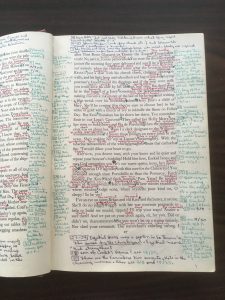
If you scroll down to the post for Dec. 19, 2018 you will see a heavily annotated copy of Finnegans Wake. My friend and regular reader of this blog, Dr. Dave McCoy, made a comment about his own copy of Finnegans Wake. I asked Dave to send me a picture and he has.
I love looking at the marginalia people put in their books and Bibles so enjoy a real pro at work here. And make sure to click the picture to enlarge it!:
It is wonderful to see publishers who care about a book’s design and aesthetics. Baylor University Press consistently hits home runs in these areas.
John Swinton has written a terrific book that makes us look more honestly at our ideas of time and how they impinge on our treatment of those with disabilities. Non-spoiler alert: we don’t do very well at either!
There is much to like about this book. It helps us wrestle with issues of great consequence and yet maintains a gracious tone throughout.
Perhaps this quote by Scott Bader-Saye from page 57 well describes the tenor of this terrific book: “The ways we experience, name, and interpret time contribute to the kinds of communities we imagine and inhabit.”
Highly recommended!
There is so very much to like about this book. I will simply list out four of my favorite things about the book:
Some shorter books like Larsen’s pack in plenty of content. If a lecture series becomes a book (as is the case with this book), there is a better than average chance that the smaller size book will have great content. You can see this with books (from another lecture series) like Andrew Delbanco’s fascinating, The Real American Dream. Larsen’s book does not disappoint as it offers the reader plenty of material.
Even though there is much content, the writing is lucid and engaging.
Larsen is an eminent historian of nineteenth-century Britain. You can always count on him to do careful archival work and know the primary sources. This book showcases those strengths.
Larsen is sensitive, as was George MacDonald, to Christians who struggle with doubt. As one who knows firsthand these struggles, I greatly appreciate Larsen’s treatment in this book.
Perhaps it is too late for a Christmas present, but how about a present for yourself for the new year?!

Frances McCormack @hatatheortan 10 hours ago
Probably my favorite pages in Finnegans Wake (although it’s hard to choose). I’ve been annotating this copy of the book since I was 16, and I now can’t decide whether I’ve created a palimpsest or a midden.
Note from David Moore: look up the definitions of palimpsest and midden if you don’t know them. Great words!
It is wonderful when a short book does a good job of addressing the major areas of an issue. You don’t expect short books to go into great detail. You do hope they are aware of the important issues.
Beth Felker Jones has written a wonderful, and yes, short book on a theology of sex. The book is barely over a hundred pages and can easily be read in a sitting or two.
Jones is winsome, writes clearly, and gives the reader confidence that this issue should matter a whole lot more than it does. Jones does a terrific job of highlighting some bogus beliefs among the Christian community that continue to hurt people needlessly.
A great introduction to an important topic!