Category Archives: Christianity
HILLARY AND TRUMP, SOMETHING IN COMMON
Actually, I refer to the similar ways their detractors speak of both candidates. And the detractors I have in mind are us Christians. By the way, I will not be voting for either, but I digress.
It is amazing to me how many Christians say if Hillary/Trump becomes president, x, y, and z terrible things WILL happen. Perhaps. But who knows the future except God, plus the history of revivals reminds us that God can do wonderful things in very dark times.
So fellow Christians here’s my message: Stop acting as if you KNOW the future. You don’t, and if you did, you might be very surprised what will occur.
DON’T BE THIS!
This came to me while I was driving the other day:
Be careful of not being a…
prickly person purveying pedantic polemics
THE END OF PROTESTANTISM?
Here is my review of an important new book. Keep in mind that those who interact with me in the comment thread come from all kinds of backgrounds.
DONE WITH CHURCH
Dones are those who still believe in Jesus, but are finished with church. Here is one perspective followed by my own reflection on why Dones exist and are growing:
MOORE CONCERNS WITH PENCE
Below, George Will well describes some of my own frustrations with Pence.
Ironically, there are some ways that my critique of Pence is more stinging than Trump. And if you are following my posts here, that is saying something! Why? Simply, because Pence ought to know better as a Christian. He is in that too large a crowd that gushes over Trump.
I can somewhat appreciate those who will hold their noses and vote for Trump. This is not what I am going to do, but I understand why some Christians might. It is rather Christians who are infatuated with Trump no matter how outrageous and immoral he is revealed to be. It just does not matter. Political expedience and access to the corridors of power seems to matter most.
HT: Roger Berry
RANDOM REFLECTIONS ON INSANITY
This bizarre and disheartening election cycle makes me recall the title of a book by Kent Hughes: Are Evangelicals Born Again? The Character Traits of True Faith.
During one of the major talks at the Republican Convention there was much more cheering for upholding the Second Amendment than remaining strong on Pro-Life.
Are some “Christian leaders” like Grape Nuts cereal? No grapes and no nuts in that cereal.
If you think the previous point is provocative, try this one on for size: The Bible makes it clear that you can cast out demons (Mt. 7: 21-23) or have your body burned (I Cor. 13:3), but not be a believer. If that’s true, then you can certainly have a seminary degree from an evangelical school and not be saved.
Do you think every professor at Liberty University agrees with Jerry Falwell’s gushing endorsement of Trump? I think it is safe to say, “No way.” So why the utter silence? Ousted board member Mark DeMoss could probably shed some light.
What has happened to people like Mike Pence, Paul Ryan, and Ben Carson?
Lot thought Sodom and Gomorrah looked good. What looks good may be horrendous. So did going into exile in Babylon. Jeremiah was one of few who knew differently. We need more Jeremiahs today!
Watching people place their loyalty and hopes in any political candidate is one of the most pathetic things imaginable for a Christian. It wouldn’t matter if its George Washington or James Buchanan.
FROM DALLAS SEMINARY TO GNOSTICISM
Richard Bullard (ThM, Dallas Theological Seminary, 1984) lived on the same floor as me in Lincoln Hall (RIP). I did not get to know him very well.
I recently found out he’s become a teacher of Gnosticism.
A sad example of spiritual confusion on many levels.
ONE SENTENCE IS WORTH THE PRICE OF THE BOOK!

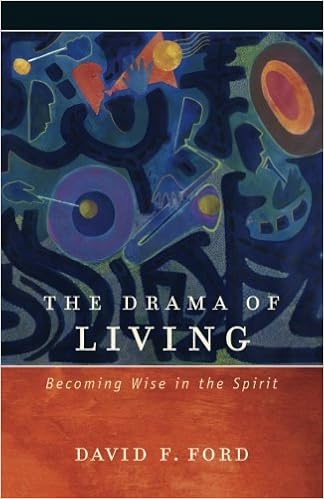
My subject line sounds ridiculous, but one sentence is full of so many implications I felt comfortable putting it down. I have never read anything quite like it in my thirty plus years of reading theology books. The sentence comes from the author’s doctoral supervisor, Donald MacKinnon: “He speculated what Christian theology would been have like if in its formative centuries it had paid more attention to the tragedies of Aeschylus, Sophocles, and Euripides than to the philosophies of the Stoics, Plato, and Aristotle.” Chew on that for a few moments.
Fortunately, David Ford’s book, The Drama of Living: Becoming Wise in the Spirit, is full of many arresting insights that you still ought to consider reading the entire book.
Ford has two conversation partners in this book: the Gospel of John and the poetry of his dear friend, Micheal O’Siadhail. It is a lively exchange throughout this marvelous work.
I should say up front that my high praise for this book does not mean I agree with everything Ford writes. When it comes to working out a distinctly Christian theology, Ford strikes me as too deferential to other religious traditions. Granted, we can learn much from those with whom we disagree, something that Ford has modeled himself. However, the scandal of the cross gets lost amid Ford’s irenic and inclusive approach. Nevertheless, there remains much to gain from a discerning read of The Drama of Living.
Ford models what he talks about with respect to lingering over important texts. Words should not be consumed (here Ford quotes Paul Griffiths), but we should “savor the words on the page…return to them ever and again.” It is akin to the point C.S. Lewis made in saying we have not read a book until we’ve reread it. Spurgeon reading Bunyan’s A Pilgrim’s Progress a hundred times is a good example. Ford’s book is written in such a way that I found myself wanting to slow down from my usual pace. Having O’Siadhail’s poetry peppered throughout was a constant reminder that The Drama of Living is unwise to speed-read.
Though Ford is a well-respected Cambridge professor, his interaction firsthand with the suffering gives him an added credibility. Ford does not escape from wrestling with this thorniest issue of all. Indeed, David Ford and his wife have been closely involved with the L’Arche community for several years. The Fords love and care for the “least of these” is beautiful and adds a deeper layer to this terrific book.
Another dimension to suffering is wonderfully laid out: that of aging and our eventual dying. Here he shares poignantly about his own father-in-law who happened to be a well-known theologian himself. Ford also shares insights from the death of Micheal O’Siadhail’s wife to Parkinsons. The insights on the power of love in these sections are truly breathtaking.
Even though I find Ford exaggerating the multiple layers of meaning in John’s Gospel due to his underscoring its “dramatic” presentation, and even though I think Ford underestimates the scandal of the cross, reading his book was indeed time well spent.

FOUNDING FATHERS GO BYE BYE
We love to invoke the Founding Fathers. It makes us feel good about our American heritage.
We admire and say we agree with what they tried to teach us about character. They believed character among our elected officials was critical to governing well.
Curiously, it seems many Christians have fallen off the planet with respect to this kind of thinking. We either are ignorant of what the Founding Fathers said about character, or worse still, we kind of know, but think it is no longer practical to expect it. I’ve seen many excuses among Christian leaders invoking, “We all are sinners” which of course is undeniably true, but using it as an excuse for expecting much of anything in our elected officials. If you expect more, you are dubbed a “purist” which is decidedly a very bad thing indeed!
So here we find ourselves as Christians still paying homage to our Founding Fathers, but clearly departing from their collective wisdom. If that is true, and it is quite evident it is, how far do you think we have slipped away from biblical truths, in discerning what God is up to in the so-called political process?
