I’m grateful that my friend, Lyle Johnson, encouraged me to watch this. Much food for thought!
LEAVING WESTBORO BAPTIST
Leave a reply

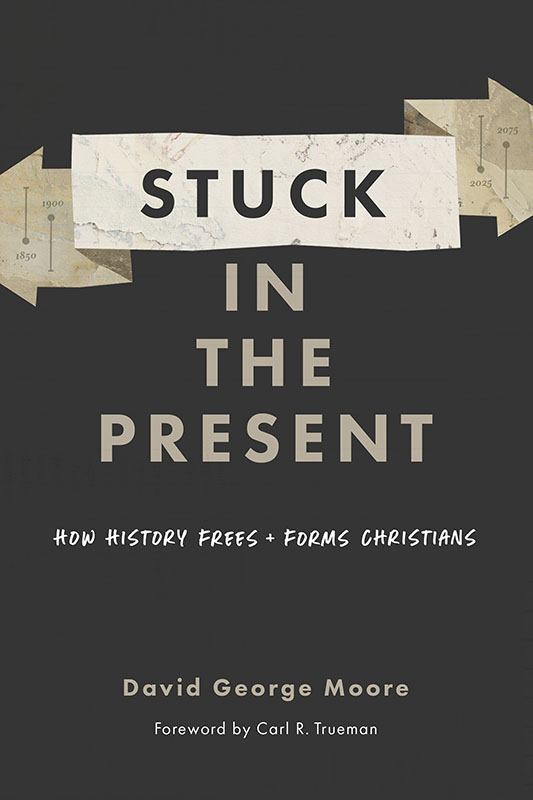
Stuck in the Present
I’m grateful that my friend, Lyle Johnson, encouraged me to watch this. Much food for thought!
When our sons were younger we spent some time in the North Caroloina home of legendary Dickens scholar, Elliot Engel. Here is a recent interview with Elliot on The Christmas Carol.
http://www.pbs.org/video/nc-weekend-christmas-carols-around-nc/

https://www.amazon.com/Imagining-Kingdom-Worship-Cultural-Liturgies/dp/0801035783
I’ve now read five of Smith’s books. From time to time, I also read his essays. He is a gifted wordsmith.
Since I’ve written elsewhere (see link below) about my main concern over what Smith has to say about liturgy, let me add that Imagining the Kingdom has many brilliant insights. And ones I largely agree with.
Smith does a better job clarifying his thesis in this book than he did in Desiring the Kingdom. I remain disappointed that he does not address the formative role that mindfully engaged (mindfully is crucial here) meditation on Scripture has for spiritual health.
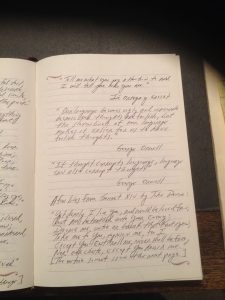
I write down many things as I read. One of my commonplace books is pictured above. They are wonderful friends who have been with me for many years.
If you are not familiar with a commonplace book, listen to this description by Tracy McKenzie of Wheaton and consider using one yourself!:
Last week I began a new feature on this blog that I am calling “From My Commonplace Book.” A commonplace book is a journal in which you record favorite quotes from what you are reading, and sometimes the thoughts that they evoke. In the 17th, 18th, and 19th centuries, it was not uncommon for students to be required to keep a commonplace book, and many of the leading lights of the American revolutionary generation did so. I’ve been doing so now for more than a year, selecting quotes that help me to think through my calling as a Christian, historian, and teacher.
I could type them on my laptop, but I like the idea of writing the quotes out by hand. For one thing, it heightens the sense that I am following in the footsteps of those who have gone before me. We live in a present-tense society that dismisses 94 percent of all the human beings who have ever drawn breath on this planet simply because they are no longer living. When I sit down to my commonplace book with pen in hand, I am self-consciously engaging in a countercultural act. It’s a symbolic gesture but no less important for that. It helps me, imaginatively, to think of myself as entering into a grand conversation about enduring questions, something far bigger than the transient fads and obsessions that so easily steal the best days of our lives.
Writing the quotes out by hand also forces me to slow down, and that in itself is a countercultural act as well. By lingering over a passage and recording it with painstaking care, I am symbolically setting it apart from the ocean of information that inundates me daily. Much of that information may be valuable, but the passages that go into my commonplace book are life-changing.
HT: My sister, Lisa
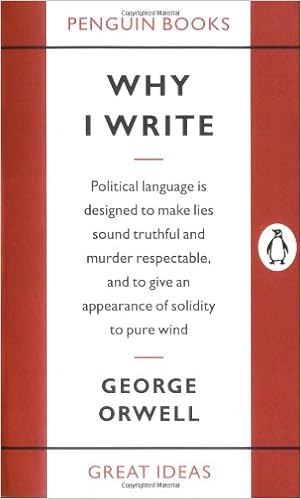
https://www.amazon.com/Why-Write-Penguin-Great-Ideas/dp/0143036351
I have loved these Penguin Great Ideas books since the time when I first laid eyes on them. Why I Write by Orwell was one of the Christmas gifts my wife gave me. I finished it on the plane this past Thursday. What a book! Only 120 pages, but packed with arresting insights and keen observations. Orwell is a master of both.
Here are a few samples:
On Neville Chamberlain
“His opponents professed to see in him a dark and wily schemer, plotting to sell England to Hitler, but it is far likelier that he was merely a stupid old man doing his best according to his very dim lights.”
The way we talk and think:
“It is rather the same thing that is happening to the English language. It becomes ugly and inaccurate because our thoughts are foolish, but the slovenliness of our language makes it easier for us to have foolish thoughts.”
And there is so much more in this funny, wise, and brilliant book!