I could argue the following at length, but will simply say…
American Christianity: more American than Christian
Modern Evangelicalism: more modern than evangelical
Conservative Christianity: more conservative than Christian

I could argue the following at length, but will simply say…
American Christianity: more American than Christian
Modern Evangelicalism: more modern than evangelical
Conservative Christianity: more conservative than Christian
My new essay on Ralph Waldo Emerson:
I would not sign it, even though I am in close agreement with the various articles. Why?
It comes across as a sterile statement from too many who were either quiet or supportive of Trump.
It is tone deaf in its timing: Charlottesville and now the flooding in Texas.
If the church in America had a better record of compassionate disagreement with gays, perhaps the statement would be okay.
I am glad, however, that this issue will force a more honest and comprehensive conversation about the Bible’s authority.
Here is a very good critique of someone who signed (HT: Peter Coelho):
I met Mike about twenty years ago. We were in the beginning stages of launching Two Cities Ministries. We had a wonderful lunch over Chinese food at a quiet place in Washington, DC. Mike was one of the most influential Christian leaders you’ve probably never heard of. He was full of energy, loved people, and was a great raconteur.
Plutarch said “small” things can reveal a man’s character. One thing stands out for me. Though Mike and I hardly knew each other he was always very quick to answer any question I sent him via email.
Through his creativity and tenacity Mike was able to win the trust of journalists across a wide swath of religious and political perspectives, no small feat!
Two questions I recently posed to Scot McKnight:
Two questions and I am looking for your quick, gut answers, especially since there is no way to know for certain. So from your own experience in ministry:
How much of an issue (from 1-10, with 10 being a semi truck sized issue) are:
The lack of compelling, joyful, wise, thoughtful, loving, and faith-filled folks over 50?
The lack of regard pastors and other ministry leaders under 40 have for the first group?
My own experience is positive. I am 59 and find lots of young men who desire time and input. However, I certainly see the effects of ageism in the church that is sadly perpetuated by too many, younger leaders.
Scot’s response:
On #1, a one or two: there are plenty.
On #2, too much but it is less that than a culture that doesn’t think in terms of wisdom but in terms of creativity and newness.
As I near sixty years old (surreal!) I am working to leave our earthly possessions in such a way as not to be a burden to our two sons. To that end, I recently sold over 100 books from our somewhat large library (around 3000 volumes). These are niche books that would not be of interest to them. Fortunately, there are several books they want, but there are still many to get rid of. I continue sift and make decisions and a new batch will be going out soon. It is an ongoing battle as new review and interview copies keep coming from various publishers. Getting rid of these books are “little deaths” and reminders of my own mortality, neither of which are cheery! However, I don’t want leave David and Chris with unnecessary burdens. The added motivation is that we can use the extra money now so it adds further incentive to be perpetually pitching.
A few days back I read about this study which adds some more motivation! (HT: Scot McKnight/Jesus Creed):
That’s pretty much what happened to 32 middle-class families between 2001-2005. I recently came across the results of this anthropological study, published in 2012: Life at Home in the Twenty-First Century: 32 Families Open Their Doors, by Jeanne E. Arnold, Anthony P. Graesch, Enzo Ragazzini, and Elinor Ochs. Together with a large research team, the authors analyzed and cataloged the visible possessions in each and every room of the 32 households—counting, documenting, examining, and coding artifacts in situ, in their place.
Devoting thousands of hours to data collection, they hoped to glean insights on the acquisition and organization of material artifacts, and on how families interacted with their possessions, and with one another. The results of the study are at once illuminating and devastating.
Their most striking findings concern the sheer magnitude of our material possessions.
Here is a Christian leader gushing over his access to power. Lord, have mercy! Sorry “ultimate selfie” is not with #45!

Ultimate selfie! Always an honor to visit with our great @POTUS! Forget #FakeNewsMedia. @realDonaldTrump is energized & determined to #MAGA!
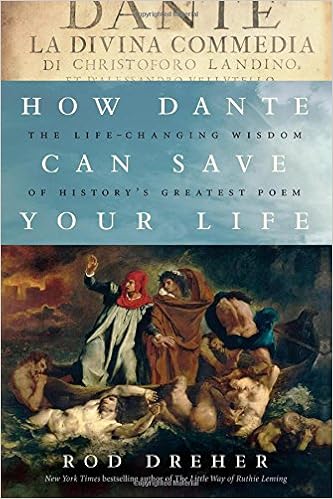
https://www.amazon.com/Dante-Save-Your-Life-Life-Changing/dp/1941393322
Journalist and gadfly, Rod Dreher, loves a good argument. If you read him, as I do, you know he can write and has loads of good things to offer. He pushes boundaries at times, sometimes makes incautious assertions, but you are always forced to think.
This is the second book I’ve read by Dreher. A few months back I read The Benedict Option book. How Dante Can Save Your Life was finished on a flight home late last night. There is much I liked about it.
First, kudos to the publisher for an absolutely stunning design. There’s nothing like real books!
Dreher’s book is full of well-written and insightful observations all while using Dante’s Comedy as his conversation partner.
My only major beef with the book is the Mommie Dearest kind of approach. It’s great to have honesty, but Dreher tells us far too much about the conflicts in his home. At times it felt like a Jerry Springer show in print.
Still, there is much to benefit from in reading How Dante Can Save Your Life.
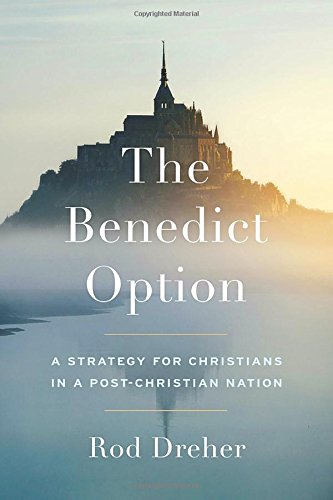
Scholars are rarely prophets and prophets are rarely scholars. I was reminded of this in reading the much debated, The Benedict Option by Rod Dreher.
Rod Dreher, journalist and outspoken Christian, is decidedly on the prophetic side of the scholar-prophet spectrum. This, however, does not mean that he is incapable of helping us better understand the far-reaching and practical ramifications of something as arcane as nominalism.
We must say right out of the blocks that Dreher’s book is not a jeremiad screed to head for the hills. Rather, Dreher advocates for “exile in place.” The preposition is key. We are to cultivate faithfulness with other like-minded folks not simply to hunker down in our religious enclaves. We should form these counter-cultural communities to strengthen our capacity to engage, not escape, our world. This is a clarion call by a gifted writer to let the church be the church.
I have my disagreements with some of Dreher’s analysis and antidotes. With respect to the former, Dreher is insufficiently aware of what the Protestant Reformers meant by sola Scriptura. As Keith Mathison memorably puts it, sola Scpritura does not mean solo Scriptura. Among other things, leaning on the thesis in Brad Gregory’s Unintended Reformation made for a potted history. Dreher would have been greatly helped if he had availed himself of the work of either Mathison or D.H. Williams, especially his Retrieving the Tradition and Renewing Evangelicalism: a Primer of Suspicious Protestants.
As to antidotes, I don’t share Dreher’s sweeping denunciation of public schools. For the record, our two sons attended Christian schools, had a few years of homeschooling, and went to public high schools. All three have their strengths and weaknesses. Sure, public schools can be a mess. I saw incompetent teachers and weak administrators, but I also saw bogus rules, unprincipled administrators and mean teachers at the Christian school. My experience, it needs to be noted, was both as a parent and a part-time teacher.
Dreher is rightly concerned about the corrosive effects of “moralistic, therapeutic, Deism.” I share his concerns. I also share Dreher’s conviction that “losing political power might just be the thing that saves the church’s soul.” As many have said, the church seems the most vital (and prophetic) when it works from the margins of power. Notwithstanding its shortcomings, Dreher’s book is a good reminder of that reality.
Click on any picture below to enlarge.
The Beinecke Rare Book & Manuscript Library at Yale is one of the world’s best. Unlike Harvard’s collection, you don’t need to wear white gloves. Once we were vetted, we were shocked by the freedom they give to scholars.
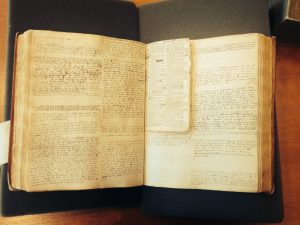
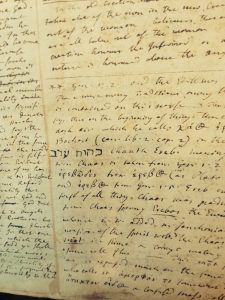
Here are a few things we looked at. First, is Jonathan Edwards Bible. Paper was rare, but Jonathan liked to write…a lot. You will see that the small sheet has the passage of Scripture and then two blank pages to take notes on what he was reading. And did he ever take notes! I did somewhat of a quick count of his handwritten notes on Genesis and each page has about 2500 words! On a similar size sheet of paper I write about 250 words.
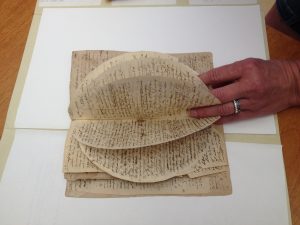
Jonathan’s wife, Sarah, along with their daughters, made fans. When the fans were no longer of use, Jonathan would take the delicate scraps and weave them into a book where he could write down sermon notes, etc.
Doreen got choked up when she held Jonathan’s Bible in her hands. The word that kept coming to my mind was “humbling” as you see the great effort Jonathan exerted to make sense of God’s Word.
Fabric from Sarah’s wedding dress.

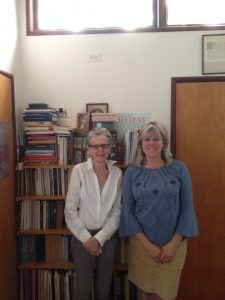
Our dear friend, Dr. Dave Mahan, is the director of the Rivendell Institute (www.rivendellinstitute.org) and teaches at Yale Divinity. Dave set us up with Susan Howe, who is a world-renowned poet. In 2017, she won the Robert Frost Medal for “distinguished lifetime service to American poetry.” Susan was a sheer delight to be with. We spent two terrific hours at her beautiful home in the country. Susan is candid about not being a Christian, but she is captivated by the beauty and respect for language she finds in Jonathan and Sarah Edwards.
I headed over to Yale’s Sterling library and was thrilled to see they have my first book.
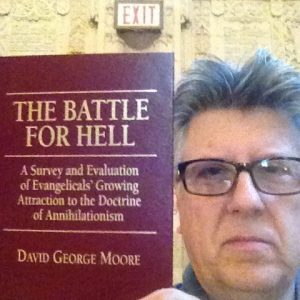
Michael McClymond is Professor of Modern Christianity at St. Louis University. Doreen met Mike in college some thirty-five years ago! She had not seen Mike since, but he happened to be at Yale the same time as us. Mike told us about his various writing projects, one of which he happened to remember quoting my book, The Battle for Hell. Mike is a wonderful guy, expert on Jonathan Edwards, and graciously offered to be a resource for Doreen with her book on Sarah.
Check out Mike’s work here: https://sites.google.com/a/slu.edu/michael-j-mcclymond/
The great folks at the Overseas Ministries Study Center made our time fun and fruitful. Many thanks to Dr. Tom Hastings, Pam Huffman, Pam Sola, Michael Racine, Ray Sola, Judy Stebbins, and the ever present help of Chee-Seng and Sharon!
Check them out at www.omsc.org.

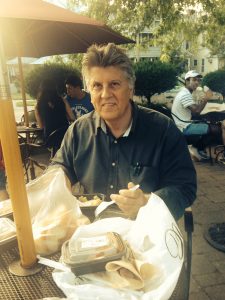
I will close with a foodie picture. This is Nica’s Market (www.nicasmarket.com), a terrific and reasonable place to grab a bite (or many bites!) to eat. The guy behind me seems skeptical about my choices, but trust me, they were good.