Category Archives: Book Review

MAKING SENSE OF GOD

I wrote in a previous interview with Tim Keller, “He has a healthy aversion to sanctimony and platitudes.  He has a low tolerance for simplistic answers.  Years of pastoral ministry in the hurly-burly of New York have given him a deep desire to articulate the Christian faith with integrity. Keller’s ability to frame old issues in fresh ways is a hallmark of both his teaching and writing. “

I’ve read six other books by Keller, but Making Sense of God (https://www.amazon.com/Making-Sense-God-Invitation-Skeptical/dp/0525954155) may now be my favorite.

All the hallmarks of Keller’s writing appear. There is an integrative approach where wonderful quotes (no, I won’t use the overused “money” quotes!) from various disciplines are used throughout the book. Keller clearly keeps up in his reading, especially when it comes to philosophy, sociology, and cultural analysis. How many pastors do you know who have read Charles Taylor’s big book, A Secular Age not once, but three times? As Keller commonly says, he reads so widely because he is “desperate.” Many of us are beneficiaries due to Keller’s desperation.

Another common feature of Keller’s approach, especially as it relates to skeptics, is what I like to call “incremental apologetics.” This is where the skeptic is moved ever slowly. No big jumps from A to Z. The skeptic is paid the respect he deserves. The skeptic is truly listened to, and maybe most importantly, is confident that Keller is portraying his positions accurately. Given these realities it is not surprising that Keller would realize a “prequel” to The Reason for God was needed.

Related to the former is what I like to call “let’s talk on the bridge.” Keller models this well in both The Reason for God and in Making Sense of God. All sides are invited into a conversation (no bomb throwing allowed) where each participant is reminded that they utilize both faith and reason. This can be a tough sell for Christians and non-Christians alike, but it is crucial if real dialogue is to occur.

Making Sense of God is strong at showcasing the problems of a materialistic worldview. The problems that ensue from the reductionism of believing that the physical world is the totality of existence are a particular strength of Making Sense of God. And Keller does not just use Christians to answer materialists like Stephen Pinker. Rather, he highlights other skeptics like Julian Barnes whose reflections on the beauty of Mozart’s Requiem made him wonder whether physical reality is the sum total of human existence.

I close with one slight disappointment and a comment about source notes.

First, the slight disappointment. Keller writes, “All of us have things we believe—including things we would sacrifice and even die for–that cannot be proven. But since these beliefs cannot be proved, does this mean we ought not to hold them, or that we can’t know them to be true? We should, therefore, stop demanding that belief in God meet a standard of universally acknowledged proof when we don’t apply that to the other commitments on which we base our lives.” Granted there is an important truth there, but believing or not believing in God is far more costly than other matters, so it is understandable why we might “demand” more evidence. There may be sufficient evidence for Christianity, but it is understandable why many of us would like more. I found this a bit too quick of a dismissal of an honest objection, something that is uncharacteristic of Keller.

It may seem rather strange to finish this review with a comment about endnotes, but I must. I regularly scan the footnotes (these days they are almost always endnotes) to see whether the author has interacted with the best literature. Not only do Keller’s endnotes demonstrate his careful reading, but there really is a book within a book.   My only concern here is that too many readers will forego reading the endnotes thinking they are unimportant, or simply too academic. For those willing to slow down and read the endnotes, they will find a treasure trove of bibliographic suggestions, further interaction, and fuller quotes.

TIM KELLER’S LATEST: THE BEST?

Image result for young tim keller

My review on Tim Keller’s latest book will be coming in the next week or so.  I’ve read six other books by Keller, but this may be my favorite.

https://www.amazon.com/Making-Sense-God-Invitation-Skeptical/dp/0525954155

I wrote in a previous interview with Keller, “He has a healthy aversion to sanctimony and platitudes.  He has a low tolerance for simplistic answers.  Years of pastoral ministry in the hurly-burly of New York have given him a deep desire to articulate the Christian faith with integrity. Keller’s ability to frame old issues in fresh ways is a hallmark of both his teaching and writing.”


ONE SENTENCE IS WORTH THE PRICE OF THE BOOK!

My subject line sounds ridiculous, but one sentence is full of so many implications I felt comfortable putting it down.   I have never read anything quite like it in my thirty plus years of reading theology books.   The sentence comes from the author’s doctoral supervisor, Donald MacKinnon: “He speculated what Christian theology would been have like if in its formative centuries it had paid more attention to the tragedies of Aeschylus, Sophocles, and Euripides than to the philosophies of the Stoics, Plato, and Aristotle.” Chew on that for a few moments.

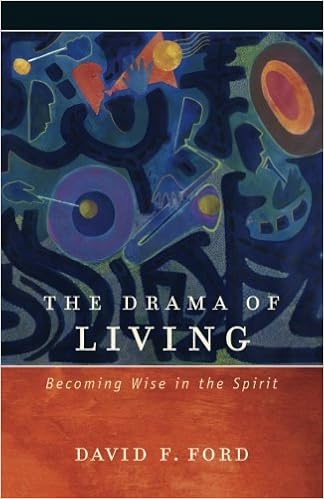
Fortunately, David Ford’s book, The Drama of Living: Becoming Wise in the Spirit, is full of many arresting insights that you still ought to consider reading the entire book.

Ford has two conversation partners in this book: the Gospel of John and the poetry of his dear friend, Micheal O’Siadhail. It is a lively exchange throughout this marvelous work.

I should say up front that my high praise for this book does not mean I agree with everything Ford writes. When it comes to working out a distinctly Christian theology, Ford strikes me as too deferential to other religious traditions. Granted, we can learn much from those with whom we disagree, something that Ford has modeled himself. However, the scandal of the cross gets lost amid Ford’s irenic and inclusive approach. Nevertheless, there remains much to gain from a discerning read of The Drama of Living.

Ford models what he talks about with respect to lingering over important texts.   Words should not be consumed (here Ford quotes Paul Griffiths), but we should “savor the words on the page…return to them ever and again.” It is akin to the point C.S. Lewis made in saying we have not read a book until we’ve reread it. Spurgeon reading Bunyan’s A Pilgrim’s Progress a hundred times is a good example. Ford’s book is written in such a way that I found myself wanting to slow down from my usual pace.   Having O’Siadhail’s poetry peppered throughout was a constant reminder that The Drama of Living is unwise to speed-read.

Though Ford is a well-respected Cambridge professor, his interaction firsthand with the suffering gives him an added credibility. Ford does not escape from wrestling with this thorniest issue of all. Indeed, David Ford and his wife have been closely involved with the L’Arche community for several years. The Fords love and care for the “least of these” is beautiful and adds a deeper layer to this terrific book.

Another dimension to suffering is wonderfully laid out: that of aging and our eventual dying. Here he shares poignantly about his own father-in-law who happened to be a well-known theologian himself. Ford also shares insights from the death of Micheal O’Siadhail’s wife to Parkinsons. The insights on the power of love in these sections are truly breathtaking.

Even though I find Ford exaggerating the multiple layers of meaning in John’s Gospel due to his underscoring its “dramatic” presentation, and even though I think Ford underestimates the scandal of the cross, reading his book was indeed time well spent.

HEY JERRY FALWELL JR. AND ROBERT JEFFRESS: PLEASE READ AND HEED THIS BOOK!

https://www.amazon.com/Onward-Engaging-Culture-without-Losing/dp/1433686171/ref=cm_cr_arp_d_product_top?ie=UTF8

Russell Moore’s latest book is a note of sanity in the midst of rampant confusion. And I am talking about Christians. Thankfully, Moore (no relation) also has the church in his gracious crosshairs.

Onward: Engaging the Culture without Losing the Gospel is a good reminder of what should be central (God, His kingdom, and the good news of gospel) and what should be secondary (American politics in this case, but everything else by way of implication).

Moore is crystal clear and compelling in the variety of ways he describes an American church being coopted by many influences and straying from the scandal of the cross. Moore is not an advocate for being foolish for foolishness sake, but he reminds us that there is an otherworldly sound to the gospel. This unusual sound is arresting to non-Christians, but as Moore does a nice job of showcasing, it can also be surprising to those of us who align with the Christian faith.

The tone of this book is respectful, loving, and hard-hitting. That triad may seem contradictory, but Moore pulls it off.

Highly recommended…and if you know Falwell or Jeffress make sure to buy them a copy!

SERIOUSLY DANGEROUS RELIGION

https://www.amazon.com/Seriously-Dangerous-Religion-Testament-Matters/dp/1481300237

There are many things to like about Provan’s book.

The writing is lucid and engaging. Provan is an author who wants his readers to understand his arguments. You don’t scratch your head wondering what he really means. This seems rather basic, but if you read a lot you learn it is not something you can always assume.

Provan is certainly tethered to Scripture, but I appreciated his integrative approach. Provan uses a wonderful array of sources from history, philosophy, and popular culture.

One of my favorite things about the book are the contrasts Provan teases out between Christianity and other world religions. These insights are worded in a way that I have not seen in any other book. They provide compelling testimony to the uniqueness of Christianity.

I don’t agree with the author on some matters, such as the extent of the Fall’s effects. However, even when I did disagree with Provan, it got me thinking in new ways that were beneficial.

Last, I read this book because I thought it would show how the more difficult claims of/about God, especially in the Old Testament, were compatible with His grace. There is some of this for sure, but I would have liked to see more interaction with the thornier issues in the Old Testament.

All in all, an extremely worthwhile read.

MEDIEVAL WISDOM FOR MODERN CHRISTIANS?

Chris Armstrong is a historian who serves as the founding director of Opus: The Art of Work, an institute on faith and vocation at Wheaton College.

The following interview centers around Armstrong’s terrific new book, Medieval Wisdom for Modern Christians: Finding Authentic Faith in a Forgotten Age with C.S. Lewis.

Moore: Many will be surprised to see medieval and modern juxtaposed in such a favorable way. Shouldn’t we Protestants move past the superstitions of the Middle Ages?

Armstrong: Well, I just disagree with the premise. So let me answer this way: The superstitions we need to move past are our own modern ones. I take “superstition” to refer to any kind of magical thinking that makes connections between causes and effects where there is in fact no demonstrable connection. Just one example will have to do here: many still believe, against overwhelming evidence, that rational ideologies will work better than traditional arrangements in the realm of statecraft.

What else can we call this but superstition or magical thinking, when this principle of rational ideology has resulted in 20 million killed in WWI, 65-80 million killed in WWII—including upwards of a quarter of a million annihilated by the dropping of atomic bombs on Hiroshima and Nagasaki—plus possibly as many as 85M – 100M killed under the Communists’ attempt to rationalize national life? This is just an extreme example of the case made by James Davison Hunter, that the belief that all our public problems will be solved when the right ideas are accepted and acted upon through political process is not Christian and it is not even truly rational—however much we (modern American Christians) want it to be. This, too, is an instance of magical thinking or “superstition.” It is a belief that does not comport with reality.

Now, were there abominable crusades, inquisitions, and thumbscrews in the Middle Ages—an era which believed that our ultimate answers are to be found not in rationalist political ideologies but in the revelations of an invisible God who came to earth as a human and lived and then died and then lived again? Certainly. Did those sinful errors of a society attempting to “live unto God” cause devastation on anything like the scale of modern superstitions such as those named above? No – not even close. And at the same time, the Middle Ages birthed the hospital and all its associated modes of medical charity; the university and its institutionalized pursuit not only of knowledge but of wisdom for living; the framework of what would become the scientific revolution (by individual believers studying to “think God’s thoughts after him”), and so much more that has blessed us even up to this minute.

Nobody’s hands are clean here, but when “superstition” caused more devastation in the hundred years between 1900 and 2000 AD than in the thousand years between 500 and 1500 AD, then perhaps it’s time to go back and study the light of wisdom enjoyed in that supposed “Dark Age.” I would even put it this way: the only reason we haven’t complete destroyed ourselves as a species is that we’re still living on the fumes of medieval wisdom.

Moore: Your book is permeated with the works and insights of C.S. Lewis. When did Lewis become such a formative figure for you? Would you mention a few of the ways his writings have been most influential?

Armstrong: I’ve known Lewis’s fictional works since I was small – my theologian father read them out loud at the table to me and my younger brothers, along with Tolkien, George MacDonald, and many others. His Perelandra deeply impacted my imagination as a young man, and when I became a Christian in my twenties, his Screwtape Letters balanced some of the wilder theories about demons in my charismatic church with the deeper and more insidious workings of our Enemy (his insight that the devil works as much by keeping things out of our minds as by putting things in by whispering in our ears is an important one).

But it was pulling the thread of his medieval understandings that led me into the depths of Lewis’s more explicitly theological and spiritual writings. I’ve found spiritual works such as Letters to Malcolm, Reflections on the Psalms, and A Grief Observed – along with his letters of spiritual advice – to be nourishing for my own spiritual life.

And I’ve come to the conclusion that the primary reason we find Lewis so illuminating for our faith and life today is not that he is a theological genius or a literary master (I actually don’t think either of these thing is true). It is that he made himself a channel of traditional Christian wisdom – a kind of living repository and transmitter of the tradition.

Moore: We Evangelicals seem to think spirituality mostly means non-material. What kinds of things can we learn from the medieval age about the tactile nature of Christian growth?

Armstrong: There are two ways modern Christians tend to approach living in our bodily, material reality. One might call these the super-spiritual and the materialist ways. They are in some senses opposite, but we fall for both of them. The super-spiritual way is to see spiritual things as higher and better and more important than material things, and therefore to find all our life’s value in what we see as the spiritual realm. In this mode, we understand Sunday worship to be a holy time, where we connect with God in all his truth, beauty, and goodness. But the ordinary, Monday-through-Saturday world in which we live as parents and workers and neighbors—we can find very little meaning or value there.

The materialist way is the way in which we live largely for material pleasures and material accumulation. We may not seriously believe that “he who dies with the most toys wins.” But we are quite capable of working long hours to ensure that our families have all the comforts of middle-class life, while falling into subtle idolatry of our suburban lifestyles, and our regular vacations, and good schools and future good salaries for our kids. Oddly enough, this materialism devalues the material world just as much as the gnostic approach. Because, as Augustine taught (and he was the premier theologian for the entire medieval period), when we treat material goods as ends in themselves, we disconnect them from their true value and meaning in God.

The medieval way stands against both of these: Its sacramental approach to the material world understands both that material stuff is not evil and meaningless, and that it is not our ultimate end and fulfilment. Instead, the material has the glorious function of pointing us to the spiritual – to God. God meets us in nature, community, work, art, science. So to live authentically as Christians, we must live in our bodies and our worlds gratefully and with wonder and openness to God working in the midst of it all. This is sacramentalism. And on this point, as on so many others, we may find real help in medieval faith.

Moore: Notre Dame historian Brad Gregory lays much blame at the feet of the Protestant Reformers for things today like our rabid individualism. To what extent, if any, would you agree with him?

Armstrong: I don’t go all the way with this argument, but I will say this: I don’t see how we can avoid the conclusion that the Protestant suspicion of tradition inserted a theological and ecclesiastical crowbar between revelation and community. And that led straight to the radical Enlightenment’s insistence that if we want to know who we are, who God is, and how we can live well in God, our only reliable guides are our own individual reason and experience. If that is really true, then we must believe only what our individual reason and experience teach us, and never the wisdom of our own community, or the wisdom handed down through past communities (which is what the word “tradition” means).

What modern, Enlightenment-influenced Christians don’t fully grasp is that if they really believe that, they must now dismiss not only such “medieval” doctrines as the Trinity, transubstantiation, and the atonement of the God-man for our sins, but also the entire canon of Scripture. For that canon was both formed and passed down in and through human community—as led (the church has always believed) by the Holy Spirit who Jesus promised would come after he left, to “guide us into all the truth.” The ball of individualism did indeed start rolling in the Reformation, and now it’s crushing all in its wake. We’ve even reached the point where evangelical seminaries figure they can do without a full-time faculty member in church history to help future ministers connect their people to the Christian past! (No, no personal bitterness or bias here!) And conservative evangelical radio personalities seriously argue that if you read church history or study the tradition, you are endangering your salvation (seriously, I’ve heard it).

Moore: You helpfully correct several misunderstandings Christians have today. One in particular for us Protestant Evangelicals is the important role of the Church’s tradition. Unpack that a bit for us.

Armstrong: I think I’ve just started to answer that, but I’ll add this:

In the book I treat this whole question of evangelical anti-traditionalism with more nuance than I can do here – but I sum up my argument in the term “immediatism.” By “immediatism,” I mean that evangelicals have long believed that the only thing that really matters to us as Christians, in the end, is that each of us can go directly, individually, to the throne of God. Because the ultimate arbiter and authority in our religion is the reasoning of our own individual minds and the experiencing of our own individual hearts, we believe we don’t need time-honored liturgies, doctrinal statements, or church polities or disciplines. We believe we don’t need to read past theologians to interpret and understand the truths God communicates to us in Scripture.

If we had time, we could talk about how unlike the church of the first 1800 or so years – really, including the earliest Protestant churches too – this modern “immediatism” is. But let me cut to the chase: if we are to live well as humans in relationship with God and each other, then we simply do need communal wisdom, both modern and traditional. For we are irreducibly social creatures whom God meets in an irreducibly social way.

From infancy, we are helpless without the love and nurture of others. A human child cannot survive as recognizably human without community (viz: feral children and the Tarzan story). And when God (who is himself a Trinity – a community) wanted to show himself to us, he did not do so through a mere communication of rules and principles to be understood and practiced through individual reason applied by individual will, nor through a mere mysticism to be experienced in the cloister of our hearts and savored in private. He did so through a relationship with generation upon generation of people-in-community – first, as the invisible God in special covenant relationship with the community of the ancient Israelites, and then as the visible God who became Immanuel, the Incarnate, embodied One—living and healing and teaching among the community of first-century Judea, sharing every inch of their humanity.

Thus the kind of individualistic religion we practice in the evangelical movement is inconsistent with the very nature of revelation – the kind of communal God-experience and God-understanding that the Old and New Testaments describe, and the ways that that communal God-experience has been handed down and studied and lived ever since. We are communal beings, and therefore God does business with us through community – and when the community transmits that God-experience and God-understanding from generation to generation, we call that “tradition.”

Moore: What are three things you hope your readers take from your book?

Armstrong: Alright, I’ve been going on too long in answering your other questions, so I’ll be brief here:

  1. There is such a thing as medieval wisdom.
  2. We need to reconnect ourselves to it.
  3. S. Lewis is a very good model and guide for how to do that.

There, how’s that?

SILENCE AND BEAUTY

https://www.amazon.com/Silence-Beauty-Hidden-Faith-Suffering/dp/0830844597

I am writing a book on how to trust God in the midst of suffering. Recent reads were Endo’s Silence followed by Makoto Fujimura’s Silence and Beauty. I made over 200 marginal notes in the pages of Endo’s Silence. It is an extremely important work for Christians to digest deeply.

Usually a commentary on a great book may be helpful and illuminating, but hardly of the caliber of the classic. This book may break this regular rule.

Fujimura’s reflections on Endo’s classic work are simply stunning. Silence and Beauty is a wonderful companion to Endo’s Silence. In fact, I would argue that Fujimura’s Silence and Beauty is indispensable to reading Endo’s work. Silence and Beauty takes you into the heart of Japanese culture and rituals. It helps you understand why Christianity is such a threat to its cultural ethos.

Silence and Beauty is wonderfully conceived and full of compelling insights. Highly recommended.

LITURGY, THE BIBLE, AND CHRISTIAN GROWTH

https://www.amazon.com/You-Are-What-Love-Spiritual/dp/158743380X?ie=UTF8&*Version*=1&*entries*=0

James K.A. Smith (aka Jamie) writes with insight and verve. He is a deep thinker who wants us to know that there is more to life than thinking. More on that in a moment.

I’ve read four of Jamie’s books: Letters to a Young Calvinist (reviewed here: http://www.patheos.com/blogs/jesuscreed/2013/06/15/david-g-moore-i-guess-im-not-a-calvinist/), Desiring the Kingdom, How (Not) to be Secular, and his latest, You are What You Love (YWYL). YWYL is designed as a more accessible version of Desiring the Kingdom, but I found both worth reading.

There is much to appreciate about the project Smith calls “cultural liturgics.” Smith has sniffed out a pervasive and naïve notion at least among American Christians: the idea that thinking alone is adequate to form us in the way Christ intends. Smith’s concern here is well founded as one can find many examples of Christians who once stuffed their heads with Bible knowledge only to find themselves now burned out, disillusioned, and adding to the growing numbers of self-proclaimed evangelicals who seek to work out their salvation autonomously. There is no doubt that Bible knowledge alone does not make one a Christ follower. Jesus warned the Jews to not confuse knowledge of the Scriptures with knowing Him (Jn. 5:39,40).

Smith forcefully argues that Bible knowledge alone is not enough. Some believe he falls prey here to a false dichotomy in correcting this error. I think that charge is unmerited. Smith gives some explicit disavowals to the contrary. Also, the body of Smith’s work makes clear that he is no anti-intellectual. Something else must be afoot rather than simply advocating a simplistic either/or option of head versus heart.

I agree that we are not just (a modifier Smith wisely employs on many occasions)“thinking-things” or ‘brains on a stick.” Smith’s view seems to be that formative liturgies are primary while biblical knowledge, essential as it may be, takes a subordinate role of sorts. He writes, “We learn to love, then, not primarily by acquiring information about what we should love but rather through practices that form the habits of how we love.” (Emphasis his)

The examples Smith gives in YWYL to demonstrate that biblical knowledge is hardly adequate for the best Christian formation are ones that sadly glut the evangelical landscape. Granted, there are many pathetic examples of ministers investing an almost magical power in acquiring biblical knowledge, but here is where I have questions. It is easy to see the foolishness of making biblical knowledge alone magical, but that begs a question of sorts. Is biblical knowledge acquired in only one way? That is, do all Christians believe that mere intellectual apprehension of biblical data is the proper way to learn Scripture?   Smith’s monolithic description of gaining bible knowledge does not consider the myriad of ways, including the healthy ones, where Christians interact with God’s Word.   Yes, we have many bad examples of a simplistic notion that learning the Bible better can automatically make one mature. However, there are Christians who come to the Scriptures with reverence, submission, and a genuine reliance on the Holy Spirit. Proper Bible knowledge is meant to lead us to the person of Christ. Smith never engages with these possibilities. Categorizing the place of all biblical thinking in a monolithically negative manner dismisses what ought to be delved into much further. David Morlan writes in his own review of Smith’s proposal that “he deals with generalities and stereotypes of churches, not actual people and actual churches.”                                                                                              

I would argue there is more of a both/and dynamic with thinking and formation rather than formative liturgies being primary. II Corinthians 10:3-5 and Romans 12:1,2 along with a more integrated/holistic anthropology (which keep the intellectual tethered to the affective) also move in that direction. The latest neuroscience from folks like Antonio Damasio shows that there is more talking going on between the so-called right and left halves of the brain than we previously imagined. I therefore find Smith’s regular refrain that we love things before we know why or that “virtue isn’t acquired intellectually but affectively” unpersuasive.

Smith claims that our “primary orientation to the world is visceral, not cerebral.” In my own discipleship ministry with men I first cover trusting God when suffering intersects one’s life. I take the men through an in depth study of Habakkuk. It is heavy biblical input while candidly working through issues of sorrow, grief, and the important role of lament. I don’t find it possible or prudent to separate the so-called visceral from the so-called cerebral. New Testament scholar, Patrick Schreiner, voices a similar concern: “I still personally wonder if the picture Smith paints is actually too neat. Maybe the process of theological anthropology is too complex to break down into humans primarily being this or that. Because isn’t the intellect a part of the body’s and heart’s process of desiring”?                                                      

Jamie Smith makes all of us think more deeply about the Christian faith. I for one have benefitted from his gifted pen, even, and maybe especially so, when I disagree with him.                                                                                                                                                      

[I am grateful to Jamie Smith for his quick response to my questions. I am also appreciative for Dennis Okholm and Scot McKnight taking the time to interact with me over the role of liturgy in spiritual formation. I alone take responsibility for the views expressed in this review.]

FOOL’S TALK

I believe this makes twelve books I’ve read by Os Guinness. I first read his Dust of Death,

followed by In Two Minds, then The Gravedigger File, and so on. None have been duds. Os has a wonderful style: accessible, but not simplistic, prophetic, yet loving. His latest is no exception. It may be my favorite so we can only hope Os has many more years of fruitful labors with his pen.

My copy of Fool’s Talk is full of marginal notes. The style is lucid, but there are places where you should pause to consider what the author is saying. I reread a number of sections because all the implications were impossible to pick up the first time.

Many are calling Fool’s Talk the greatest work by the author. I certainly resonate with that assessment as this particular work seems to gather many elements which have been percolating for a long time in the author’s mind.

One quick comment needs to be made about the beautiful book design. Kudos to InterVarsity Press for their great care and professionalism in both content and presentation. In every way, Fool’s Talk is truly a work of art!

Highly recommended! http://www.amazon.com/Fools-Talk-Recovering-Christian-Persuasion/dp/0830836993/ref=cm_cr_arp_d_product_top?ie=UTF8