“Culture will eat strategy’s lunch every time.”
Attributed to Peter Drucker

God, What on Earth are You Doing?
“Culture will eat strategy’s lunch every time.”
Attributed to Peter Drucker
John Wilsey is Assistant Professor of History and Christian Apologetics and Associate Director of the Land Center at Southwestern Baptist Theological Seminary. His first book, One Nation Under God: An Evangelical Critique of Christian America, argues that America was not founded as a Christian nation but as a nation with religious liberty.
Wilsey’s book, American Exceptionalism and Civil Religion: Reassessing the History of an Idea (http://www.amazon.com/American-Exceptionalism-Civil-Religion-Reassessing/dp/083084094X/ref=la_B00DXLOTGE_1_1?s=books&ie=UTF8&qid=1458851128&sr=1-1) framed this interview.
Moore: To what degree, if any, was the previous work you did in One Nation Under God? a catalyst for writing this book?
Wilsey: Yes, this book is an outgrowth of my research from One Nation Under God. That work originated as my PhD dissertation. I noticed while surveying the Christian America literature from 1977 to 2007 that American exceptionalism was entailed in the Christian America thesis. I spent a few pages describing how this was so in One Nation, but I did not have the space to devote a fuller attention to it. So, I decided to pursue a book length study on exceptionalism after One Nation was published.
Moore: You describe two different types of American exceptionalism: open and closed. Briefly sketch what they are and why it matters.
Wilsey: Exceptionalism is a loaded and ambiguous term, and the purpose of the book is to attempt to offer precision in how we understand what it means. To do that, I wanted to look at the history of exceptionalism as an idea going back to the Puritans of the 17th century and also to consider what theological commitments exceptionalism entails.
I argued in the book that exceptionalism has had strong theological commitments throughout American history. Still, exceptionalism has also been articulated in political/social forms, too. I call the theological forms of exceptionalism “closed exceptionalism” because these forms divide people into either the Chosen or the Other. Thus, theological, or closed, exceptionalism is exclusive. But “open exceptionalism” is based on the liberal founding ideals of the nation as expressed in documents such as the Declaration of Independence, the Bill of Rights, the Emancipation Proclamation, and Lincoln’s Second Inaugural. Open exceptionalism, because it does not generally appear in imperialistic or theological ways, is inclusive.
Moore: There are plenty of politicians on the right who have a closed form of American exceptionalism. Are there any politicians, either moderates or liberals, who articulate a closed form of American exceptionalism?
Wilsey: Interesting question. Because the Democratic Party has largely abandoned its interventionist policies that defined the Truman, Kennedy, and Johnson administrations, closed exceptionalism has not been as widely embraced by those on the left. Obama is likely the most strenuous advocate of American exceptionalism on the left today, but the brand he extols is definitely open exceptionalism.
The most recent figure on the left to argue for closed exceptionalism would probably be Lyndon Johnson. An example of how he articulated closed exceptionalism is in his 1966 speech, “The Obligation of Power.”
Moore: For those who hold to an open form of American exceptionalism, are there any grounds to apologize for past abuses to Native Americans and African-Americans?
Wilsey: Of course. One of the features of open exceptionalism is national self-examination and the acknowledgement that not everything we have done as Americans is just. This is a tradition that goes back to the Puritan jeremiad, a genre of literature that calls members of the community back from their sins and backslidings to return to faithfulness to their covenant with God.
When Ronald Reagan acknowledged past abuses to Japanese Americans during World War II by offering reparations, this is an example of how open exceptionalism can take a step toward correcting past wrongs.
Moore: Other than Russell Moore, I haven’t seen many Southern Baptist leaders decry the immensely troubling endorsements of Trump by the likes of Jerry FalwelI Jr. or Robert Jeffress. I pay pretty close attention to the news and have been dismayed (but sadly not surprised) by the lack of critical scrutiny. I would like to buy each one of them a copy of your book, but I’m not convinced it would move the needle much. If you had the chance to sit down with those men, what would you say to them?
Wilsey: Another great question! I might sit down with these brothers of mine in Christ and take them to 2 Chronicles 7:14. We’d look at the verse, as well as the context of that verse as it is situated in the larger passage of chapters 1-7. I would show them how to interpret the passage in its immediate historical context, but more importantly, how Christ fulfills the passage in his redemption of humankind through his death, burial, and resurrection. It is centrally because of Christ that we do not think about nations and lands being chosen by God. Christ is God, having come down to us as one of us and in bringing reconciliation through his atonement for sin. There is no longer any need for chosen nations and lands, because God now dwells with His people, the universal church.
Moore: You write some very helpful things about not confusing loyalty with conformity. You are addressing what it means to be a good citizen, but your discussion is very applicable to what I’ve seen in many Christian organizations where those raising legitimate concerns can be marginalized for being “critical spirits.” Would you unpack a bit more about the importance of not confusing loyalty with conformity?
Wilsey: Sure. True loyalty does not overlook faults. True loyalty brings faults into the light so that those faults might be corrected. Proverbs 27:6 tells us that “Wounds from a friend can be trusted, but an enemy multiplies kisses.” This is referring to personal relationships, but the same can be said about patriotism. The notion of “America, right or wrong” is thoroughly unhelpful, and has gotten the nation into trouble in the past. On the other hand, protest movements that have stood against injustice—particularly the civil rights movement and the pro-life movement—help the nation be confronted with its sins and figure out ways to correct evil trends.
Moore: What are a few things you hope your readers will take away from your fine work?
Wilsey: Thanks for the interview!
I hope readers will see that embracing closed exceptionalism is not an appropriate way to express patriotism. As I wrote in the book, true patriotism does not equal absolute agreement with everything the nation is doing. What happens when the nation begins trampling upon the rights of freedom of religion or freedom of speech? What happens when our own friends, neighbors, family members—even ourselves—are persecuted for what we say or what we believe? True patriotism entails standing up for the right, and opposing the wrong, as Lincoln famously said in many of his speeches and writings. America is historically an exceptional nation, and exceptionalism as a political/social construct built on the founding ideals puts us on a path to responsible civic engagement.
It is common to see Christians use the 1+1+1=1 equation to describe the trinity. Their intention is good, but I think utilizing this equation as an illustration of the trinity is misguided.
When we look at the equation we conclude that the trinity is irrational. All our lives we have known 1+1+1=3 not 1. But now we are instructed that there is a heavenly math of sorts where it equals 1.
I was sharing the gospel with a Muslim years ago at the University of Texas in Dallas. He said he could never become a Christian because the trinity was irrational. I shared with him that irrational is not the right word. Mysterious to be sure, but not irrational.
Irrational would mean we are saying God exists simultaneously as one Person and three Persons. Another irrational option would be to say God exists simultaneously as one Being and three Beings. But of course, Christians don’t believe either one of these things.
We do believe that God is one in His Being or Essence, yet three in Person. Each Person is fully God not 33.333% God. That is why you can’t conceptualize the trinity. It is indeed beyond our understanding, but that does not make it irrational.
I asked my Muslim friend if he could conceptualize everything about Allah. He conceded that he could not. He could not get his head wrapped around such things as God being uncaused or self-existent. I asked if he thought uncaused or self-existent would be irrational. “Not if He is God,” he replied. Of course, it would be irrational to say God is both self-existent and dependent on someone/thing else for His existence.
So let’s drop the 1+1+1=1 for the trinity. We don’t want to give the impression that belief in the Christian God is irrational. Mysterious and beyond our comprehension to be sure, but not irrational.
http://www.amazon.com/Deep-Work-Focused-Success-Distracted/dp/1455586692
Cal Newport is the best-selling author of such books as So Good They Can’t Ignore You: Why Skills Trump Passion in the Quest for the Work you Love and How to Become a Straight-A Student: the Unconventional Strategies Real College Students Use to Score High While Studying Less.
Cal teaches computer science at Georgetown University in Washington DC. The following interview is over Newport’s latest book, Deep Work: Rules for Focused Success in a Distracted World (http://www.amazon.com/Deep-Work-Focused-Success-Distracted/dp/1455586692/ref=asap_bc?ie=UTF8).
Moore: Give our readers a feel for the impetus behind writing this book.
Newport: We spend so much time wringing our hands over distraction that we’ve forgotten what’s so valuable about its opposite. If you hone your ability to work deeply, and prioritize this activity, you’ll become much more successful, and your professional life will become more satisfying. This seemed like a message worth sharing.
Moore: You provide some wonderful examples (including your own) of those who have been able to accomplish considerable work-related goals without being stressed workaholics. Why do most of us equate productivity with long hours and significant stress?
Newport: Not all work is created equal. If you spend all day answering emails between jumping on calls and attending meetings, you might feel busy, but you should not feel proud. You did very little that created new value or made you better at your craft. Once you recognize the value that true deep work creates, it becomes easier to treat the shallow alternative with suspicion – a nuance at best, a serious obstacle at worst, in your quest to make an impact on the world.
Moore: A computer scientist can’t be a Luddite, but you find Facebook and Twitter a waste of time. However, you do regularly blog. Personally, I am in the same boat: regular blogging, but no Facebook and Twitter. Preach to the non-choir who think Facebook and Twitter are the best things since sliced bread.
Newport: There’s a difference between being a Luddite and being picky about which technologies you allow to lay claim to your time and attention. There are a lot of technologies I love. But there are also a lot that I think are nonsense. I include most social media in the latter category. These commercial services are cleverly designed to prey on your quest for social approval and craving for lightweight distraction so that your eyeballs and personal data can be harvested then sold to advertisers. I have a hard job and two young kids at home. I want to preserve the small amount of free time that remains in my life for more meaningful pursuits.
Moore: During my time in radio I had the opportunity to interview Neil Postman for the hour. He was insightful in writing about the tradeoffs which come with new technology. Unpack that a bit for us.
Newport: Neil was a gifted and influential media critic. Among the many things he wrote about, an idea of his that stuck with me is the danger of the “technopoly.” In short, he warned that we have a tendency to deify new technologies as being intrinsically good and a prophetic source of wisdom regarding how best to run our governments, companies, and personal lives. I think we’re definitely seeing this play out today. When I say, for example, that Facebook is stupid, even if not everyone agrees with this claim, this really shouldn’t be that controversial—but I find instead that it throws people into a tizzy. This is the mark of a technopoly: dissent is seen as desecration not debate.
Moore: You have to do a lot of “deep work” for your role as college professor and writer. Should the rest of us be concerned about setting up our schedules in such a way that we can also do deep work?
Newport: Yes. Deep work is like a super power for many, many different knowledge work professions. To quote The Economist: “Deep work is the killer app of the knowledge economy.” There are three reasons to embrace deep work. First, if hone your ability to concentrate, you can produce significantly better output in significantly shorter time. Second, deep work allows you to learn complicated things quickly. And third, it makes your life more meaningful and satisfying. We were created to create things of value—not send emails.
Moore: I found your book a great encouragement for what I am doing right and a further motivation to tweak my schedule so as to allow for increased deep work. Two book projects are propelling me forward! What would you say are a few reasons why people ought to consider buying your book?
Newport: The book has two parts. The first part makes the case for deep work. If you’re on the fence, or if you’re a believer but want more ammunition to convince others, you’ll find what you need in part one. The second part provides detailed practical instructions for how to better cultivate and apply deep work in your own life. So if you’re looking to improve your ability to work deeply, this part will provide exactly what you’re looking for.
For used books, and a whole lot of other things like this nifty Lodis organizer for a whopping $1.99.

A history teacher during my sophomore year of high school introduced me to tricks for how to memorize (commonly called mnemonic devices). He gave us the example of the word HOMES for the five great lakes: Huron, Ontario, Michigan, Erie, and Superior. Though I learned that list over forty years ago, and though I don’t have to review it, I can call it up just as easily today.
More on memory can be found in this TED talk:
Seven and a half years of study. No breaks whatsoever. How are we Christians doing?
Soon I will be interviewing Cal Newport on his terrific book, Deep Work: Rules for Focused Success in a Distracted World http://www.amazon.com/Deep-Work-Focused-Success-Distracted/dp/1455586692
Cal teaches computer science at Georgetown and has written a book underscoring the type of work which is increasingly rare and thus valuable. One example can be found in blacksmith, Ric Furrer. The care and integrity of Ric’s work is amazing. I wonder what it would look like if Christians read their Bibles and studied with such care.
“I think ironically American evangelicals often seem to be more followers of Benjamin Franklin that they are of Jonathan Edwards. They [evangelicals] admire practicality, friendliness, moralisms, easy formulas, and quantifiable results. And while these Franklin-esque traits aren’t all bad they sometimes contribute to evangelical superficiality.”[1]
George Marsden
[1] George Marsden, “The Legacy of Jonathan Edwards,” Beeson Divinity School, Nov. 12, 2004. Emphasis added. The two major feeder streams coming early into American culture are the Enlightenment and Puritanism. See David A. Hollinger, “The Accommodation of Protestant Christianity with the Enlightenment: the Old Drama Still Being Enacted,” Daedalus, the Journal of the American Academy of Arts & Sciences, 141 (1) Winter 2012 and Marshall Shelley and David Goetz, “The Weapons of War: an Interview with James Davison Hunter, Leadership Journal, Spring 1993: 14-15.
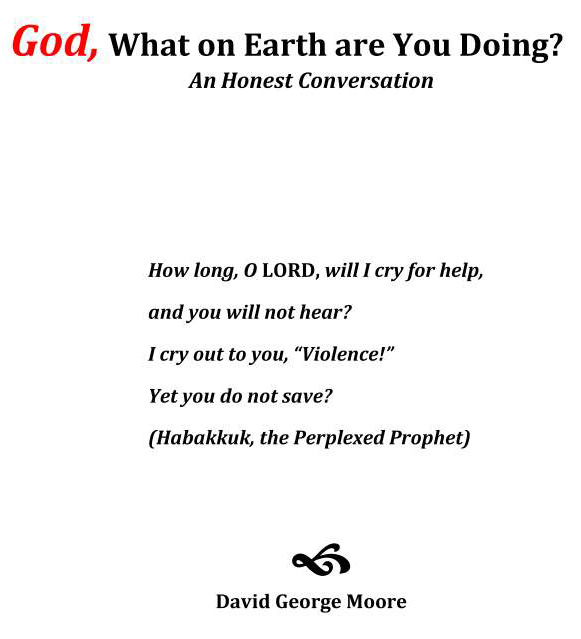
Some of you know that I am trying to finish a book on trusting God in the midst of suffering. It is titled, God, What on Earth are you Doing? an Honest Conversation. Here is a picture of the process: