God, What on Earth are You Doing?

PRINCIPLES OR PILGRIMAGE?

Several years back I had a conversation about spiritual growth with a close friend.  Ben was bemoaning the fact that churches generally give little input to parents on getting their teenagers ready for adulthood.

I agreed with Ben, but told him there is an underlying problem–the dominant model of Christian growth in so-called conservative churches is behavioristic.  In other words, we mainly focus on people keeping their spiritual noses clean, and the way we do this is by having them jump through various hoops (read programs) we are have set up as indispensable.

These programs (they no longer feel like ministry) tend to promote disembodied principles rather than appreciating the metaphor of a journey or pilgrimage.  Granted, there are many invaluable principles to remember, but the Christian life should not be reduced to them.  Complexities which get reduced to simplicities where it is not warranted are labeled by philosophers as “reductionistic.”  It seems evangelical America is guilty of a dangerous form of spiritual reductionism.  

A journey or pilgrimage with its many twists and turns takes into consideration the uncertainties of life.  It also underscores, as Will Willimon likes to say, “a richer, thicker Chrisitan life.”  It further reminds us, as John Bunyan did so well in The Pilgrim’s Progress, that every Christian’s path of growth has challenges and opportunities for growth which are unique.  And that is indeed a refreshing truth amidst cookie-cutter approaches to Christian growth!

WAR: WHAT IS IT GOOD FOR?

U.N.: Syrian war criminals should face ICC

I am sure many of you will remember the famous anti-Vietnam song which was first sung by The Temptations.

Syria got me thinking about whether the song was correct in saying war is good for “absolutely nothing.”

It is maddening navigating with wisdom in a chaotic, confused, and fallen world.

No doubt there are issues of justice and charity to grapple with when it comes to grotesque events like the war in Syria, but what are we as Americans to do?

I am not so sure our overall philosophy (do we even have one?) of military might is the right one.  

I am not a full-blown pacifist, but I do think we get involved militarily in far too many wars.  Precious resources, most prominently human life, get squandered far too often.  

Perhaps a debate about our overall philosophy is due, an extended conversation where Americans from all parties meet at the table of ideas.  Naive I know to dream about such things, but anything shy of it seems to perpetuate the problem we regularly find ourselves in: a selective and inconsistent strategy that has us calling on the military when there are other non military options which should have been employed.

What do you think?


DAILY RITUALS

In his endlessly fascinating book, Mason Currey gives us a peak into the inner motivations of writers, artists, and other creative types.

One of my favorite shows is “In Depth” on Book TV.  And my favorite part of that show is where we are given access to the writing spaces of the featured author.  Having watched that show for many years confirms that no two writers have the same pattern.  Every writer (or creative type) is unique.  Currey also makes this plain in his wonderfully wrought book.

Here a few, other things I took away from reading Currey’s book:

*The power of good habits and the struggle to develop them!

*Creative folks must create.  There is a drive, even compulsion to do so.

*It is wise to have a steady means of income as it is difficult, especially at first, to make a living in the creative arena.

*Find your own voice because no one else has it!


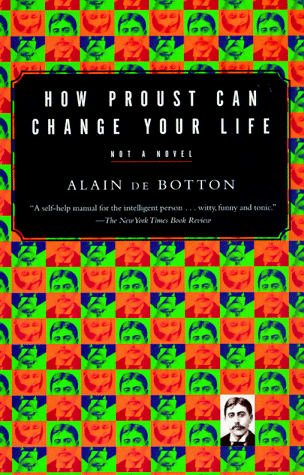
HOW PROUST CAN CHANGE YOUR LIFE

One of my favorite books is How Proust Can Change Your LIfe.  It is less than two hundred pages, but jam packed with wonderful insights.  The author is an engaging and winsome writer.  And he is an atheist.  His view of the world is much different than mine, but he has a terrific way of explaining important matters.

Here is a two minute clip of the author explaining what great literature can do:

http://www.youtube.com/watch?v=-C8cD_uYKK8

THE POPE, SEX, AND AN ATHEIST

I know.  The title sounds like the start of a joke.

Here is what atheist, Richard Dawkins, tweeted when Benedict made it public he would retire:

“I feel sorry for the Pope and all old Catholic priests. Imagine having a wasted life to look back on and no sex.”

(Richard Dawkins, Tweet, Feb. 11, 2013)

Sex must take on a sort of transcendence if you are an atheist/materialist like Dawkins.  That is the truly pathetic thing!

IS THE PEN MIGHTIER THAN THE SWORD?

It is a well-known and regularly retrieved saying, but do we really believe “the pen is mightier than the sword?”

It seems the sword is being employed a lot these days.  It also seems right to conclude that the sword being used so often is proof that it works.  Why else use it?

Christians extol the power of the Word.  God’s Word is “…living and active, sharper than any two-edged sword…”  (Heb. 4:12)

When I observe governments grabbing the sword as the first or only option, I know their ideas must not be very compelling.

Poet, playwright, writer/Czech Republic president (in that order!) said, “I really do inhabit a system in which words are capable of shaking the entire structure of government, where words can prove mightier than ten military divisions.”