God, What on Earth are You Doing?

IS VOTING FOR TRUMP A “MORALLY GOOD CHOICE”? RESPONDING TO WAYNE GRUDEM

A personal word is in order. Wayne Grudem was the faculty adviser for both my wife and me during our time at Trinity Evangelical Divinity School (TEDS). Wayne was also the first reader on my thesis and a great encouragement during my two years at TEDS.

My friend, Paul, sent me Wayne’s piece, “Why Voting for Donald Trump is a Morally Good Choice.” (http://townhall.com/columnists/waynegrudem/2016/07/28/why-voting-for-donald-trump-is-a-morally-good-choice-n2199564). Wayne’s article is rather long, but there are a few points that warrant a friendly challenge.

Among others, John Mark Reynolds and Matthew Boedy have weighed in on a variety of issues (http://www.patheos.com/blogs/eidos/ and http://www.patheos.com/blogs/warrenthrockmorton/2016/07/30/the-rhetorical-maneuvers-of-wayne-grudem-a-guest-post-from-matthew-boedy/?ref_widget=trending&ref_blog=eidos&ref_post=a-good-man-justifies-a-wicked-deed-grudem-on-trump).

In my own post I want to address a few biblical matters that impinge directly on whether someone is in fact making a wise decision by voting for Trump.

I’m not sure that Wayne using “flaws” to describe Trump’s character is the best word to use. At the very least the connotations of “flaws” as a slight offense or peccadillo seems not strong enough to fit Trump’s overall character. Well-intentioned people can disagree on this one, so I am fine moving on to other matters.

Along with many others, Wayne writes, “He has raised remarkable children.” It is easy to see why so many say this sort of thing, but what are we in fact saying? Do we think Trump and Trump alone is responsible for how his children turned out? Furthermore, aren’t we assuming that what we observe about the Trump children in public (respect for their dad, well-spoken, hard-working, etc.) is the totality of their character? What do we really know about Donald Jr., Eric, Ivanka, Tiffany, and Barron? Precious little, I would argue. They might be people of substance and consistent character, but our quickness in being impressed is misplaced.

There is another problem that arises from drawing a straight line from how good a parent must be by the ways their children turned out. Think of King Josiah. He had a bad grandfather (Manasseh) and not much better father (Amon). Then Josiah, a righteous king of note, had some notorious sons, especially Jehoiakim and Zedekiah. And don’t forget the models of Eli and Samuel with their own sons.   The Scriptures should humble those of us whose children turn out and encourage those of us whose children may be wayward.

Moving on, Wayne left out the most egregious thing about Trump: his claim of not needing to ask God for forgiveness.   Fortunately, Wayne did not compare Trump to King David, as Jerry Falwell Jr. did. Unlike Trump, King David understood both the consequences of his sin (Ps. 32) and the need to seek God’s forgiveness (Ps. 51).

Elsewhere in his piece, Wayne makes a point by retrieving a verse from the book of Jeremiah:

“Therefore I take seriously the prophet Jeremiah’s exhortation to the Jewish people living in exile in Babylon: ‘Seek the welfare of the city where I have sent you into exile, and pray to the LORD on its behalf, for in its welfare you will find your welfare.’ (Jeremiah 29:7)  By way of modern application, I think Christians today have a similar obligation to vote in such a way that will ‘seek the welfare’ of the United States. Therefore the one overriding question to ask is this: Which vote is most likely to bring the best results for the nation?” (Emphasis his)

I am a bit leery with the analogy Wayne employs here. First, some context to Jer. 29:7 is in order. Jeremiah had been telling Judah to stop resisting the noxious idea of going into Babylon as exiles. It was not a popular message. The false prophets said Jeremiah was crazy and couldn’t be hearing rightly from God. The false prophets had a much different idea: Judah should cozy up to the Egyptians and have them provide protection against the evil Babylonians.

So who would be the modern equivalents to Babylon and Egypt? Most Christians I hear are saying Hillary is clearly the worst of the two candidates. If that were the case, wouldn’t Hillary represent Babylon/Nebuchadnezzar and Trump be Egypt? Not only do I think Wayne’s example a poor one, but it seems to undercut the very point he wishes to make.

Sticking with the book of Jeremiah a bit more, remember that God calls the wicked Nebuchadnezzar “my servant” on three different occasions (Jer. 25:9, 27:6, 43:10). God remains in control even with the likes of Nebuchadnezzar, something that strikes me as crucial to remember this election year!

Wayne writes “I am writing this article because I doubt that many ‘I can’t vote for Trump’ Christians have understood what an entirely different nation would result from Hillary Clinton as president.” (Emphasis mine) Using “would” here was incautious. Elsewhere, Wayne modifies his comments with “likely” or “most likely.” Wayne also mentions “…we can never know the future conduct of any human being with 100% certainty…” It’s unfortunate his piece is not consistent throughout in this regard. I don’t think “likely” or “most likely” are great, but they are certainly to be preferred over “would.”

Historian, Mark Noll, likes to say that Abraham Lincoln was the best theologian during the Civil War. It is a provocative observation, but rings true when you see so many of that time assuming God was on their side. Lincoln was different. He underscored the inscrutable nature of God’s providence.


HEY JERRY FALWELL JR. AND ROBERT JEFFRESS: PLEASE READ AND HEED THIS BOOK!

https://www.amazon.com/Onward-Engaging-Culture-without-Losing/dp/1433686171/ref=cm_cr_arp_d_product_top?ie=UTF8

Russell Moore’s latest book is a note of sanity in the midst of rampant confusion. And I am talking about Christians. Thankfully, Moore (no relation) also has the church in his gracious crosshairs.

Onward: Engaging the Culture without Losing the Gospel is a good reminder of what should be central (God, His kingdom, and the good news of gospel) and what should be secondary (American politics in this case, but everything else by way of implication).

Moore is crystal clear and compelling in the variety of ways he describes an American church being coopted by many influences and straying from the scandal of the cross. Moore is not an advocate for being foolish for foolishness sake, but he reminds us that there is an otherworldly sound to the gospel. This unusual sound is arresting to non-Christians, but as Moore does a nice job of showcasing, it can also be surprising to those of us who align with the Christian faith.

The tone of this book is respectful, loving, and hard-hitting. That triad may seem contradictory, but Moore pulls it off.

Highly recommended…and if you know Falwell or Jeffress make sure to buy them a copy!

SERIOUSLY DANGEROUS RELIGION

https://www.amazon.com/Seriously-Dangerous-Religion-Testament-Matters/dp/1481300237

There are many things to like about Provan’s book.

The writing is lucid and engaging. Provan is an author who wants his readers to understand his arguments. You don’t scratch your head wondering what he really means. This seems rather basic, but if you read a lot you learn it is not something you can always assume.

Provan is certainly tethered to Scripture, but I appreciated his integrative approach. Provan uses a wonderful array of sources from history, philosophy, and popular culture.

One of my favorite things about the book are the contrasts Provan teases out between Christianity and other world religions. These insights are worded in a way that I have not seen in any other book. They provide compelling testimony to the uniqueness of Christianity.

I don’t agree with the author on some matters, such as the extent of the Fall’s effects. However, even when I did disagree with Provan, it got me thinking in new ways that were beneficial.

Last, I read this book because I thought it would show how the more difficult claims of/about God, especially in the Old Testament, were compatible with His grace. There is some of this for sure, but I would have liked to see more interaction with the thornier issues in the Old Testament.

All in all, an extremely worthwhile read.

MEDIEVAL WISDOM FOR MODERN CHRISTIANS?

Chris Armstrong is a historian who serves as the founding director of Opus: The Art of Work, an institute on faith and vocation at Wheaton College.

The following interview centers around Armstrong’s terrific new book, Medieval Wisdom for Modern Christians: Finding Authentic Faith in a Forgotten Age with C.S. Lewis.

Moore: Many will be surprised to see medieval and modern juxtaposed in such a favorable way. Shouldn’t we Protestants move past the superstitions of the Middle Ages?

Armstrong: Well, I just disagree with the premise. So let me answer this way: The superstitions we need to move past are our own modern ones. I take “superstition” to refer to any kind of magical thinking that makes connections between causes and effects where there is in fact no demonstrable connection. Just one example will have to do here: many still believe, against overwhelming evidence, that rational ideologies will work better than traditional arrangements in the realm of statecraft.

What else can we call this but superstition or magical thinking, when this principle of rational ideology has resulted in 20 million killed in WWI, 65-80 million killed in WWII—including upwards of a quarter of a million annihilated by the dropping of atomic bombs on Hiroshima and Nagasaki—plus possibly as many as 85M – 100M killed under the Communists’ attempt to rationalize national life? This is just an extreme example of the case made by James Davison Hunter, that the belief that all our public problems will be solved when the right ideas are accepted and acted upon through political process is not Christian and it is not even truly rational—however much we (modern American Christians) want it to be. This, too, is an instance of magical thinking or “superstition.” It is a belief that does not comport with reality.

Now, were there abominable crusades, inquisitions, and thumbscrews in the Middle Ages—an era which believed that our ultimate answers are to be found not in rationalist political ideologies but in the revelations of an invisible God who came to earth as a human and lived and then died and then lived again? Certainly. Did those sinful errors of a society attempting to “live unto God” cause devastation on anything like the scale of modern superstitions such as those named above? No – not even close. And at the same time, the Middle Ages birthed the hospital and all its associated modes of medical charity; the university and its institutionalized pursuit not only of knowledge but of wisdom for living; the framework of what would become the scientific revolution (by individual believers studying to “think God’s thoughts after him”), and so much more that has blessed us even up to this minute.

Nobody’s hands are clean here, but when “superstition” caused more devastation in the hundred years between 1900 and 2000 AD than in the thousand years between 500 and 1500 AD, then perhaps it’s time to go back and study the light of wisdom enjoyed in that supposed “Dark Age.” I would even put it this way: the only reason we haven’t complete destroyed ourselves as a species is that we’re still living on the fumes of medieval wisdom.

Moore: Your book is permeated with the works and insights of C.S. Lewis. When did Lewis become such a formative figure for you? Would you mention a few of the ways his writings have been most influential?

Armstrong: I’ve known Lewis’s fictional works since I was small – my theologian father read them out loud at the table to me and my younger brothers, along with Tolkien, George MacDonald, and many others. His Perelandra deeply impacted my imagination as a young man, and when I became a Christian in my twenties, his Screwtape Letters balanced some of the wilder theories about demons in my charismatic church with the deeper and more insidious workings of our Enemy (his insight that the devil works as much by keeping things out of our minds as by putting things in by whispering in our ears is an important one).

But it was pulling the thread of his medieval understandings that led me into the depths of Lewis’s more explicitly theological and spiritual writings. I’ve found spiritual works such as Letters to Malcolm, Reflections on the Psalms, and A Grief Observed – along with his letters of spiritual advice – to be nourishing for my own spiritual life.

And I’ve come to the conclusion that the primary reason we find Lewis so illuminating for our faith and life today is not that he is a theological genius or a literary master (I actually don’t think either of these thing is true). It is that he made himself a channel of traditional Christian wisdom – a kind of living repository and transmitter of the tradition.

Moore: We Evangelicals seem to think spirituality mostly means non-material. What kinds of things can we learn from the medieval age about the tactile nature of Christian growth?

Armstrong: There are two ways modern Christians tend to approach living in our bodily, material reality. One might call these the super-spiritual and the materialist ways. They are in some senses opposite, but we fall for both of them. The super-spiritual way is to see spiritual things as higher and better and more important than material things, and therefore to find all our life’s value in what we see as the spiritual realm. In this mode, we understand Sunday worship to be a holy time, where we connect with God in all his truth, beauty, and goodness. But the ordinary, Monday-through-Saturday world in which we live as parents and workers and neighbors—we can find very little meaning or value there.

The materialist way is the way in which we live largely for material pleasures and material accumulation. We may not seriously believe that “he who dies with the most toys wins.” But we are quite capable of working long hours to ensure that our families have all the comforts of middle-class life, while falling into subtle idolatry of our suburban lifestyles, and our regular vacations, and good schools and future good salaries for our kids. Oddly enough, this materialism devalues the material world just as much as the gnostic approach. Because, as Augustine taught (and he was the premier theologian for the entire medieval period), when we treat material goods as ends in themselves, we disconnect them from their true value and meaning in God.

The medieval way stands against both of these: Its sacramental approach to the material world understands both that material stuff is not evil and meaningless, and that it is not our ultimate end and fulfilment. Instead, the material has the glorious function of pointing us to the spiritual – to God. God meets us in nature, community, work, art, science. So to live authentically as Christians, we must live in our bodies and our worlds gratefully and with wonder and openness to God working in the midst of it all. This is sacramentalism. And on this point, as on so many others, we may find real help in medieval faith.

Moore: Notre Dame historian Brad Gregory lays much blame at the feet of the Protestant Reformers for things today like our rabid individualism. To what extent, if any, would you agree with him?

Armstrong: I don’t go all the way with this argument, but I will say this: I don’t see how we can avoid the conclusion that the Protestant suspicion of tradition inserted a theological and ecclesiastical crowbar between revelation and community. And that led straight to the radical Enlightenment’s insistence that if we want to know who we are, who God is, and how we can live well in God, our only reliable guides are our own individual reason and experience. If that is really true, then we must believe only what our individual reason and experience teach us, and never the wisdom of our own community, or the wisdom handed down through past communities (which is what the word “tradition” means).

What modern, Enlightenment-influenced Christians don’t fully grasp is that if they really believe that, they must now dismiss not only such “medieval” doctrines as the Trinity, transubstantiation, and the atonement of the God-man for our sins, but also the entire canon of Scripture. For that canon was both formed and passed down in and through human community—as led (the church has always believed) by the Holy Spirit who Jesus promised would come after he left, to “guide us into all the truth.” The ball of individualism did indeed start rolling in the Reformation, and now it’s crushing all in its wake. We’ve even reached the point where evangelical seminaries figure they can do without a full-time faculty member in church history to help future ministers connect their people to the Christian past! (No, no personal bitterness or bias here!) And conservative evangelical radio personalities seriously argue that if you read church history or study the tradition, you are endangering your salvation (seriously, I’ve heard it).

Moore: You helpfully correct several misunderstandings Christians have today. One in particular for us Protestant Evangelicals is the important role of the Church’s tradition. Unpack that a bit for us.

Armstrong: I think I’ve just started to answer that, but I’ll add this:

In the book I treat this whole question of evangelical anti-traditionalism with more nuance than I can do here – but I sum up my argument in the term “immediatism.” By “immediatism,” I mean that evangelicals have long believed that the only thing that really matters to us as Christians, in the end, is that each of us can go directly, individually, to the throne of God. Because the ultimate arbiter and authority in our religion is the reasoning of our own individual minds and the experiencing of our own individual hearts, we believe we don’t need time-honored liturgies, doctrinal statements, or church polities or disciplines. We believe we don’t need to read past theologians to interpret and understand the truths God communicates to us in Scripture.

If we had time, we could talk about how unlike the church of the first 1800 or so years – really, including the earliest Protestant churches too – this modern “immediatism” is. But let me cut to the chase: if we are to live well as humans in relationship with God and each other, then we simply do need communal wisdom, both modern and traditional. For we are irreducibly social creatures whom God meets in an irreducibly social way.

From infancy, we are helpless without the love and nurture of others. A human child cannot survive as recognizably human without community (viz: feral children and the Tarzan story). And when God (who is himself a Trinity – a community) wanted to show himself to us, he did not do so through a mere communication of rules and principles to be understood and practiced through individual reason applied by individual will, nor through a mere mysticism to be experienced in the cloister of our hearts and savored in private. He did so through a relationship with generation upon generation of people-in-community – first, as the invisible God in special covenant relationship with the community of the ancient Israelites, and then as the visible God who became Immanuel, the Incarnate, embodied One—living and healing and teaching among the community of first-century Judea, sharing every inch of their humanity.

Thus the kind of individualistic religion we practice in the evangelical movement is inconsistent with the very nature of revelation – the kind of communal God-experience and God-understanding that the Old and New Testaments describe, and the ways that that communal God-experience has been handed down and studied and lived ever since. We are communal beings, and therefore God does business with us through community – and when the community transmits that God-experience and God-understanding from generation to generation, we call that “tradition.”

Moore: What are three things you hope your readers take from your book?

Armstrong: Alright, I’ve been going on too long in answering your other questions, so I’ll be brief here:

  1. There is such a thing as medieval wisdom.
  2. We need to reconnect ourselves to it.
  3. S. Lewis is a very good model and guide for how to do that.

There, how’s that?

SILENCE AND BEAUTY

https://www.amazon.com/Silence-Beauty-Hidden-Faith-Suffering/dp/0830844597

I am writing a book on how to trust God in the midst of suffering. Recent reads were Endo’s Silence followed by Makoto Fujimura’s Silence and Beauty. I made over 200 marginal notes in the pages of Endo’s Silence. It is an extremely important work for Christians to digest deeply.

Usually a commentary on a great book may be helpful and illuminating, but hardly of the caliber of the classic. This book may break this regular rule.

Fujimura’s reflections on Endo’s classic work are simply stunning. Silence and Beauty is a wonderful companion to Endo’s Silence. In fact, I would argue that Fujimura’s Silence and Beauty is indispensable to reading Endo’s work. Silence and Beauty takes you into the heart of Japanese culture and rituals. It helps you understand why Christianity is such a threat to its cultural ethos.

Silence and Beauty is wonderfully conceived and full of compelling insights. Highly recommended.

PRINCETON LOG #3: PEOPLE

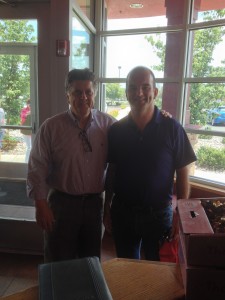
The past two posts on Princeton have focused on places.  This one focuses on people.  My last week Princeton included four wonderful days with some terrific folk.  My first was with well-known artist and author, Makoto Fujimura or Mako for short.  Mako has recently written an absorbing book called Silence and Beauty.  It is a commentary of sorts on Shusaku Endo’s novel, Silence

photo 1(1)

We took a day trip to Yale.  There we met with David and Karen Mahan.  Doreen worked with Dave at Virginia Tech in the early 1980s. Both of them were on staff with Campus Crusade for Christ (Cru).  I met Dave during the summer of 1985.  Our son, Chris, is looking into various graduate programs. Yale is one of his possibilities so it was wonderful that he could join us. 

photo 2(1)

James McPherson is widely hailed as our greatest living historian of the Civil War.  In 1989 he won the Pulitzer Prize for his magisterial book, Battle Cry of Freedom.  I spoke with Professor McPherson on how various people processed the carnage of the war.

photo 3(1)

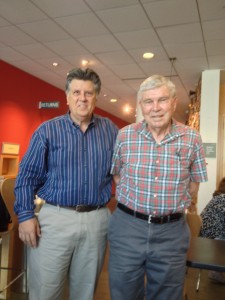
My week finished up with Carl Trueman, Professor of Church History at Westminster Theological Seminary.  Carl and I have corresponded via email, but never met in person.  He is a terrific historian and wonderful essayist. Make sure to check him out on First Things and Mortification of Spin.

photo 4

PRINCETON LOG #2: WHAT WE’RE STUDYING (AND A NOTE ON PURGATORY)

Yesterday, we posted a picture outside of Payne Hall.  Here is our living room:

photo 1

Here is the huge balcony we share with one other apartment:

photo 2

Princeton is a walking town, so we (gladly) do lots of it everyday.  A few pictures of our walk with a couple of the University which is right across the street from the quaint town.

photo(2) copy

photo 2

photo 1

photo 2(1)

photo 1(1)

photo 1(1)

photo 2(1)

Some spots along our daily walk to the library:

photo 3(1)

photo 1(1) copy

photo 2(1) copy

photo 4

You may have heard me mock pastors who say they are “married to the most beautiful woman in the world.”  I like to jest that she must be getting very tired.  Well, I think it is fair to say that the day the following picture was shot I could safely say I was married to the most beautiful woman in the library.

Doreen had no idea I was taking a picture, but now she will be on to me.  She is doing research on Sarah Edwards, wife of Jonathan.  As many of you know, her first book covers the marriage of Jonathan and Sarah, along with the Whitefields and Wesleys.  I happy to say that the Princeton library carries her book along with two of mine.

photo 2-3

The burial place of Jonathan and Sarah Edwards.  Also, the graveyard for John Witherspoon, Aaron Burr, and many more.

photo-11 copy 2

My spot in the library:

photo 3-2

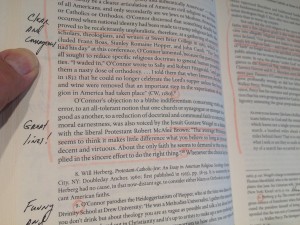
I am finishing up a thirty-five year study of how to trust God in the midst of suffering.  One of my final reads is Ralph Wood’s utterly amazing book on Flannery O’Connor.  At my current pace, this 280 page book will have over 500 marginal notes.  It is one of the most insightful and beautifully written books I’ve ever read.  If you choose to read it, go very slow and bring out your pen!

photo-11 copy

Protestants don’t tend to believe in Purgatory.  I have joked that looking at someone’s photos of their family vacation can feel like Purgatory exists.  Hopefully, you will find this log more celestial in nature.

PRINCETON LOG #1: GETTING THERE

Packed and ready to go:

photo 1

Dinner (and spent the night) with wonderful friends, Bill and Helen.  A great restaurant Bill and Helen introduced us to:

Breakfast in Dallas with our oldest son, David, who works for Deloitte:
photo 1
Driving over the Mississippi River:
photo 1 copy
Feeling peace because our dog, Dexter, is in the terrific hands of our friends, Bill and Diana.  Note well his Napoleon complex!
photo 4
Spent night in Knoxville with Doreen’s sister and brother-in-law.  Met a new family member.  He cried right after this picture was taken.  It had nothing to do with my skills, but everything to do because the little guy was hungry.  That’s my story…
photo 2 copy
Stopped at Wayside Inn in Middletown Virginia.  We stayed here twenty-five years ago when Doreen was pregnant with David.
photo(3)
photo(2) copy
Asymmetrical is critical when Doreen drives:
photo(2) copy
Arrived in Princeton.  Our place is the second floor with balcony.  Surrounded by history and beauty on every corner.
photo 5
Coming up next: What we are researching and writing.

AGING

One way I’ve thought of aging: It is a secret society which your younger self barely knew existed.  Quicker than you can imagine you are made a member of the club.  The dues are very steep!

HOW TO SIGN A BOOK

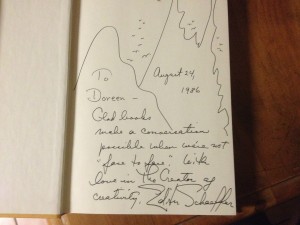
I’ve done some book signings for my own books.  Several writer friends have put nice notes to me in copies of their books.  But none have done what Edith Schaeffer did when I asked (in the summer of 1986) her to sign a book for my then girlfriend, Doreen!  By the way, it was perhaps the most idyllic place I’ve been: out in the Swiss country surrounded by the Alps.

photo(2) cop