
God, What on Earth are You Doing?

SUFFERING BIBLE: CRITICAL REVIEW

Here is my Patheos review of a new Bible:

I am currently writing a book (and speaking in various places) about what it means to trust God when suffering intersects our lives. It is the culmination of thirty years of wrestling with the issue…and not just theoretically.

My dear friend, John, who himself has experienced much suffering recommended this new Beyond Suffering Bible. (https://www.amazon.com/Beyond-Suffering-Bible-NLT-Struggles/dp/1414395582) The good folks at Tyndale graciously sent me a copy.

I received a paperback version. I’m not sure whether the thin pages apply to other versions, but this one has extremely delicate paper. As an inveterate note-taker, I would prefer thicker paper. I know the arguments against thicker paper, but that is definitely my preference.

The idea behind this Bible is terrific. Joni Eareckson Tada is a great model to lead this project. Her reflections, which pepper the text throughout, are realistic, joy-filled, and honor God. Other contributors add their own reflections.

My main disappointment is with the scant commentary. Some significant verses related to suffering are passed over (e.g. Job 2:13; II Cor. 7:6), verses that are commonly taken out of context receive no commentary (Jer. 29:11; Lam. 3:22,23), and other verses commonly taken out of context receive too little commentary (Rom. 8:28; I Cor. 10:13). For this last example, the commentator does not commit the common error of saying I Cor. 10:13 is a proof text for “God never giving you more than you can handle.” I am glad for that, but it is unfortunate that the commentary here did not make clear that the context is addressing idols. The promise is that God will never allow us to be unduly tempted to believe loyalty to idols is our salvation rather than the true God.

Since many Christians struggle with the reality that God has indeed given them more than they can handle, this is a crucial area that should have been addressed.

I like the heart behind this Bible, but further editions should include many other relevant verses on suffering, and offer more teaching on popular verses we thought we knew already.


OBAMA’S WISE COUNSEL TO HIS DAUGHTERS

What President Obama told his daughters about Trump:

“What I say to them is that people are complicated,” Obama told me. “Societies and cultures are really complicated … This is not mathematics; this is biology and chemistry. These are living organisms, and it’s messy. And your job as a citizen and as a decent human being is to constantly affirm and lift up and fight for treating people with kindness and respect and understanding. And you should anticipate that at any given moment there’s going to be flare-ups of bigotry that you may have to confront, or may be inside you and you have to vanquish. And it doesn’t stop … You don’t get into a fetal position about it. You don’t start worrying about apocalypse. You say, O.K., where are the places where I can push to keep it moving forward.”

HT: Karen Swallow Prior Twitter Account

The rest is here:

http://www.newyorker.com/magazine/2016/11/28/obama-reckons-with-a-trump-presidency


THREE QUESTIONS…FOR ALL OF US

The presidential election is now history.  I came up with three questions I would love to have all voters answer:

Our founding fathers believed character was integral to governing well. Do you think this is still relevant?

What personal revelation about your candidate of choice would have caused you to change your mind about voting for him/her?

On a scale of one to ten, with ten being the worst, how intoxicated do you think you are with the corridors of political power?

ACTIVE READING

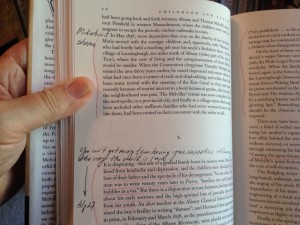
I regularly get asked to recommend books which is a privilege and delight.  Less frequently, I am asked what process/strategies I use for reading.  When I do, I mention the following.  Books are not created equally so lesser lights don’t get the following treatment, but many do.

Here is my copy of the wonderful Melville: His World and Work by Andrew Delbanco.  I am very interested in the challenges to the Christian faith that arose in the nineteenth century America. 

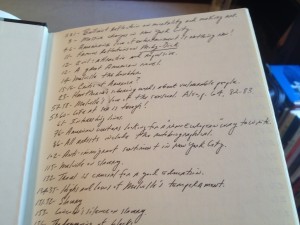
For years, I’ve used a red pencil to highlight and either a black pen or pencil for marginal notes.  I don’t always make an index as in the second photo, but it is not uncommon.

photo-11

photo-21


FROM RACISM TO RECONCILIATION

Eventually, Wallace said his father considered his life’s greatest victory to be not his four terms as governor or the millions of presidential votes he secured around the country, but his faith and relationship with God.

After the assassination attempt, Wallace wrote to the gunman, Arthur Bremer.

“He told him that he loved him and he had forgiven him. And he told Arthur Bremer if you’ll ask our lord and savior Jesus Christ into your heart, we’ll be together in heaven,” Wallace said.

“He told me once, ‘If I can’t forgive him, the Lord won’t forgive me.’ ”

The rest is here: http://www.tuscaloosanews.com/news/20120608/son-says-former-gov-george-wallace-repented-for-past

MANY EVANGELICALS AREN’T EVANGELICALS

Evangelical has become merely a name for many who gladly identify with the label.  A related moniker, Bible-believing Christian, is also quite a farce as many identifying with that label are woefully ignorant of what the Bible says.

How about the word conservative or conservative Christian?  Well, two tenured friends at separate Christian colleges told me they would have been fired for speaking out against Trump.  Whether these individuals are correct in that assessment or not, that was their perception.  And we so-called conservatives mock that the free exchange of ideas does not take place in the secular academy.  Rom. 2:1!


DON’T FORGET!

If you are trying to persuade someone, keep in mind this insight from David Hume:

“And as reasoning is not the source, whence either disputant derives his tenets; it is vain to expect, that any logic, which speaks not to the affections, will ever engage him to embrace sounder principles.”

(As quoted in Haidt, The Righteous Mind, p. 57)


POST ELECTION WRAP

A friend asked for my thoughts on things like the “lesser of two evils” argument which have been widely used along with a number of other arguments in favor of Trump.  My brief response:
The common refrain that our forefathers fought for “the right to vote” misses an important point. People like Madison et al. believed character was non-negotiable to good governance. As one pol sci scholar told me in a recent interview, Madison and his ilk would tell me to vote according to my conscience which is not seamless with the need to have to vote
Additionally, I don’t share how powerful the president is going to be. Both the left and right make this mistake. I think the next administration if I were to predict (and my historical sense tells me to steer clear of the prediction business!) will be quite ineffectual and hamstrung. 
Last, I think a good argument can be made by Christians that Trump is much worse because he has confused many over the gospel. I’m not voting for Hillary but at least she does not confuse people over the gospel. 
P.S. I did vote, but bypassed voting for any presidential candidates.

TOO SARCASTIC?

“No other country houses so many gorgeous frauds and imbeciles as the United States, and in consequence no other country is so amusing. Thus my patriotism is impeccable, though perhaps not orthodox.  I love my country as a small boy loves the circus.”

H.L. Mencken as Quoted in Writers to Read: Nine Names that Belong on Your Shelf by Douglas Wilson

https://www.amazon.com/Writers-Read-Names-Belong-Bookshelf/dp/1433545837