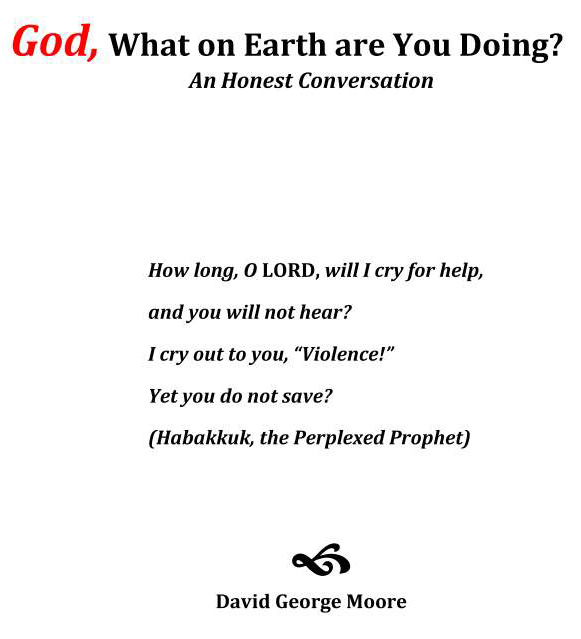
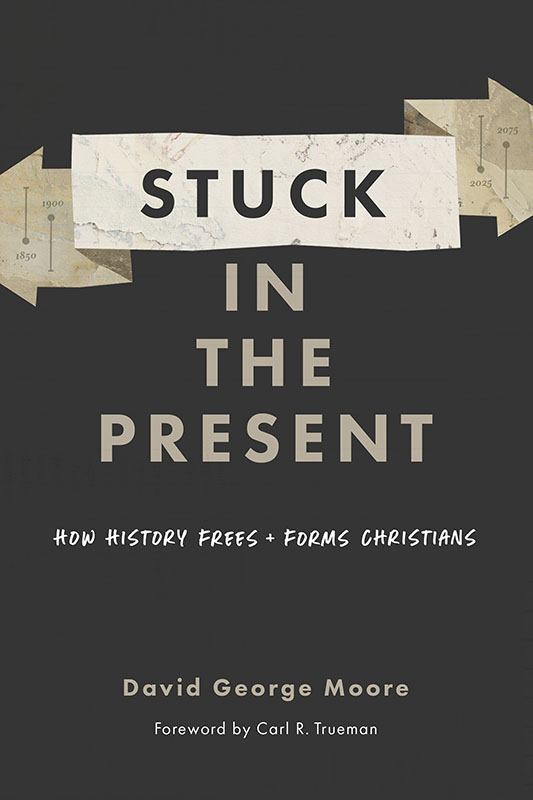



God, What on Earth are You Doing?

TIM KELLER’S GO TO BOOK

I recently interviewed Tim Keller.

During that interview, I asked this question:

Moore: I have read four of your books (The Reason for God, Counterfeit God, Every Good Endeavor, and Walking with God Through Pain and Suffering). Though they are very different books, I noticed that all four cite Andrew Delbanco’s, The Real American Dream: a Mediation on Hope. Why is that book so formative to your thinking?

Keller: It is a terrific analysis of contemporary American culture, put into the context of American history. Delbanco says that American cultural history has had three phases—each one centering on one high priority. He lists them: “God. Nation. Self.” I don’t think you can improve on the simplicity and penetration of that analysis.

I don’t think his book is necessarily more formative than any other book to my thinking, but it is so broadly applicable—to psychology, vocation, politics, sexuality, religion, or whatever. That’s why it’s hard not to cite it, no matter what the subject.

Now that I have finished Delbanco’s book, I concur wholeheartedly.

MOORE REFLECTIONS ON WAR

This past Sunday evening I was catching up with my dad.  It turned out both of us had seen a little bit of the annual show PBS does to honor the military.  My dad is a life-long conservative.  He and my mom were very involved in trying to get Barry Goldwater elected.  Even though I was young at the time, I still recall them going off  to a dinner party/fundraiser for Goldwater at the Camelback resort.

In any case, my dad who served as an officer in the Navy during WWII is sick of war.  And so am I.  Both of us had to turn off the PBS special not because we don’t want to honor the soldiers, but because we don’t want to honor war.  And the former many times seems to bleed effortlessly over into the latter.  War is hell.  Those three words are pregnant with meaning.  Interestingly, it seems the ruthless William Tecumseh Sherman is responsible for coming up with the saying.  Here is one version of the quote.  It comes from an address Sherman gave in 1879 to the Michigan Military Academy:

“I’ve been where you are now and I know just how you feel. It’s entirely natural that there should beat in the breast of every one of you a hope and desire that some day you can use the skill you have acquired here.
Suppress it! You don’t know the horrible aspects of war. I’ve been through two wars and I know. I’ve seen cities and homes in ashes. I’ve seen thousands of men lying on the ground, their dead faces looking up at the skies. I tell you, war is Hell!” (per Wikiquote)

It seems another General living about a century after Sherman ought to be considered more in these discussions.  I speak of General Dwight D. Eisenhower.  Eisenhower raised concerns that the amount of money and power involved in making war greatly colors our judgment.  

Yes, some wars seem unavoidable.  And yes, some seem to fit various moral criteria, but are we too quick to pick up arms when other means have not been properly considered?  I think it is safe to answer in the affirmative.


PASTOR TURNED SKEPTIC

A short time ago I read an article about a former pastor who became a skeptic.  The post 9/11 world did not make sense to him.  He figured there could be no God in such a world.  This kind of struggle of course is nothing new.

Andrew Delbanco has famously said Americans went from believing in the providence of God prior to the Civil War to believing in luck after it.  Too much carnage took place for one to keep believing in a God who is both good and in control of all things.

I also struggle to make sense of these realities, yet I am perplexed by those who choose to bail on the Christian faith.

The Bible makes it clear that we are living in a broken world where the most hideous things imaginable will take place.  Make sure to digest that important truth.  If “delicate women” will boil their own children for food (see Deut. 28:53-57), we know there is the capacity for all kinds of evil.

Further, if God had not made it clear that I will not understand many things this side of heaven, I also would consider bailing on the Christian faith.  However, God has made it clear we will only know in very small part.  There is quite a bit in Scripture on this truth (for example Deut. 29:29; Job 38-42; Isa. 55:8,9; I Cor. 13:12)

Luther, like the Psalmists (note plural) struggled with the silence of God, even the God who seems to hide Himself at times.  We should be glad for the candor of Scripture, but also chastened to remember we only now see in a “mirror dimly.”

So I wonder what Bible the pastor who bailed was reading.